Sunday, December 23, 2018

Around and In the Church of the Nativity

I suppose, with Christmas Eve approaching tomorrow, this is the propitious time to be mentioning my visit inside the Church of the Nativity at the end of November. My reading tells me that it is the oldest complete Christian Church, originally built during the reign of Constantine. Bethlehem is under the aegis of the Palestinian Authority and not Israel. There was a "checkpoint" to enter, but again, my sense is that being on a tour bus rather immunizes the pilgrim from any unpleasantness and the group was ushered into the little town in which Christ was born. Upon our arrival at the parking lot, Doron uttered his by now well loved exhortation, "We walk!" and the group marched the several blocks to Manger Square and the spot where Tradition says (since the second century) God entered into an unsettled time, as all time with humanity has proven itself to be.


The tree was up in a Manger Square which seemed more cramped than I imagined it would be. 


Or perhaps that is as it should be, for Our Lord was born in a small, crowded space. We wended our way to the courtyard of the Church, actually, it turns out that there are two Churches adjacent. If my memory serves, it was the newer Church (built in the 19th Century) that we stepped into first, after we bowed low to get through the humility door (a four foot tall entrance courtesy of the Ottomans circa the 15th century who didn't want carts and thiefs going through the larger entrance) and because at that point I didn't know about the co-existing Churches (St. Catherine of Alexandria is in the custody of the Franciscans; the Church of the Nativity is with the Orthodox) I was jarred by its modernity. There was something going on in the "new" Church and the sweet voice singing Silent Night in a language I did not recognize required reverent attention

Our first stop was one of the Caves underground, The Cave of St. Jerome, where Fr. Francis said our second Mass of the pilgrimage. As much as I had felt a sense of the sacred in the Chapel at the Church of the Holy Sepulchre, I felt it with more intensity here underground. It felt ancient and mysterious. We were told, I believe, that behind the wall shared by the chapel was where the Manger lay. We had not yet seen that spot. In some ways, it was enough to be close meditatively than it would be as we were ushered quickly by it later. I could sense a little of what it might have been like for early Christians celebrating Mass in hiding from the Romans. And yet, it felt warm and safe to me. 


And then we went into the old Church, no longer the one of Constantine, that was destroyed someplace in the sixth century, though there are some mosaics still extant and being re-discovered today. It was rebuilt by the Emperor Justinian sometime in the same period, and this is basically the Church that we saw. After years of dispute and covering up of many of the religious artistic expressions, like mosaics of angels, this Church is being renovated, and it does have much of the look of a construction site, a holy one nonetheless. Restoration is underway, and has revealed images under cover for hundreds of years due to religious disputes and jealousies not among Christians and Jews, but among the Christian faiths themselves, much like at the Church of the Holy Sepulchre.


Although the line was not particularly long, we had to wait a long time to be allowed inside imposing doors leading to the Manger site. Finally, we were close. 


As often happened, there were spots where photos became difficult, if not allowed at all. The doorway here going down into a cave, is the entrance to where the Holy Family sought refugee. Again, a security person wasn't going to allow any lingering, in a place where lingering seems essential. But again, I realize I saw more than I thought I had. And so, here it is from the net, courtesy of Smithsonian.org. 


As with Calvary, I wished I could just sit there, but so did the many Pilgrims before, and after us, and those to come. Whether this is the certain spot, we cannot know, but we do know that it has been reverenced since very shortly after the events which it memorializes. Certainly, I said to myself, "I am closer than I will ever be in Los Angeles to the unfolding of salvation history!" Well, not really, as salvation history encompasses all humanity for all times and in all places. But it was nice to be at the epicenter. 

And then we were back outside taking a group photo. I don't know how many of these wonderful people I met for this pilgrimage I will continue to know, as life has gone back to the ordinary for all of us from different places within and outside California, but I can say that I am delighted I will be able to recall them for the remainder of my life just by a quick glance at this shot which reflected, to my mind, the grace we all felt. 


It is hard to remember that this was only the second day of our journey together. There was so much more to come, if even there can be "more" than what we already saw. I suppose from here we spent our time in the "in between", between His birth and His Death and Resurrection--His Life on this earth. And some other archeological, theological and historic sites besides.  

But before that, we sampled the wares of a local on the way to the bus. That was some good bread and falafel. 


Blessed Christmas to all, and may peace come to the Earth!

Monday, December 17, 2018

The Western Wall

On that first full whirlwind day in Jerusalem, our group visited the one remaining standing part of the Second Temple, destroyed in 70 A.D. by the Romans--the Western Wall. Just a week or so before a friend who knew that I was going to be taken a Pilgrimage to Israel sent me a video. It showed a group praying on the Mt. Of Olives overlooking the Old City when an unexplained mist began rising
That it was eerie is of no dispute. Apocalyptic? Well, that is hard to say, except that if anything Apocalyptic is likely to happen, it would happen in that area. There is a belief by many Jews that the Messiah will be arriving out of the Eastern Gate of Jerusalem that was sealed by Suleiman the Magnificent, ostensibly to prevent the happening.

https://youtu.be/ByqMLfeYYOs

Now that I have been in the general vicinity, I recognize where the men in the video were standing, overlooking also a very ancient cemetery. I saw no mist when I visited the Wall, which abuts the Temple Mount (which we could not visit because it was closed when we came), but God's Presence could certainly be felt as we explored the courtyard and joined those so reverently praying ahead of us at the Wall. I somehow had expected the length of the Wall to be more extensive based on photographs and even on that video I had seen, but it was impressive enough if only for its survival and its importance to this very day.


One of the happy by-products of this Pilgrimage are some of the things I learned, surprising things, small and large, along the way. Here is one. Notice the big bushy thing protruding out of the wall? These plants were everywhere on the walls throughout the City. They are capers--yes, the plant that bears the little things you eat in your salads, after much cutting, selecting, pruning and pickling. And having read a little since I returned, these plants have been compared to the Jews themselves, having the ability to survive even when cut to the roots. 

Women and men do not approach the Wall together. There is a strict, Orthodox, separation. I seem to remember someone near me, maybe one of our own group, complaining about the dichotomy. For me, somehow it was of no serious objection, perhaps because, though I am a woman who has neither married nor had children, and lived a life that many would say was a model of feminism (having had a career of my own and supported myself), I believe that we all are given different gifts and roles by God, and that the separation is a recognition of those natural dichotomies of body, mind and soul. In any case, I think as far as the Western Wall, critique is a ship that has sailed. And so, off I went to say a prayer for my mother, and for a couple of friends, attached to a note to be placed in one of the cracks in spiritual emphasis. 

I waited my turn. I was impressed by the intense reverence around me., and by the sense of the many who had come here before over years and years past. And now, I was one of them. It's pretty powerful stuff. And something else. I have never understood anti-Semitism from Christians. And now, I understand it less. There would be, for me, no Catholicism, the faith I practice, without the extended history of the Jews. They are indispensable to what we believe. We would not exist as a faith, but for them. (I hope that my Jewish cousins don't mind the expression of this view of our connection; it is meant with a gratitude only.)


I leave you with a video snippet. In the background, you can hear a Muezzin doing the Call to Prayer for Islam. As Mr. Spock would say, "Fascinating". 


From the Western Wall, we went to an ancient palace, inside the City, that some say is that of King David, though it is disputed. (In all things of human discussion, there is dispute, it seems!)  I think by this time, as the end of the day was upon us, I was exhausted in taking pictures, so I just absorbed. But here is a link to a video about this archeological gem.  

https://youtu.be/NZhFteuv9Is

All I can say to those of you who dispute even the existence of David--I hear you are out there--is that the Bible, The Torah and the New Testament connects very nicely to so many of the ruins discovered in the past and still being unearthed as we speak. But whether you believe in the Kings, the Prophets or the Messiah, it is all pretty spectacular. 


Sunday, December 16, 2018

The Journey into Jerusalem


It was just after dark when our group arrived from Tel Aviv, where we landed, to Jerusalem, a bit under an hour's bus drive away. Although we had begun our journey on Friday afternoon, it was already Saturday evening, as we had catapulted ten hours into the future by virtue of the spinning of the earth and a fourteen hour trip.

I could see nothing of the surroundings, but only of the highway that led to our first lodging, a Leonardo Hotel (there are several).


My initial impression as we drove in the darkness was that I could be in Los Angeles. Underpasses were of the same type of concrete, and the highway signs were green. But for the fact that the exits were labelled in Hebrew, Arabic, then English, it would not have seemed any different than a night drive at home.

The hotel, though, was bustling, and clearly with tourists from every place in the globe, along with locals.


Breakfast and dinner were included in our package. Once relieved of our luggage, the group met, for the first time, in the large buffet room. We were known henceforth as "Fr. Francis' Group". Fr. Francis Benedict from Saint Andrew's Abbey was our spiritual guide for the pilgrimage. All of us had some connection, tenuous to substantial, with the Abbey, located in the Mojave Desert in California, which sponsored the trip.

A few people already knew one another, but most of us were strangers. That would change quickly. By the second or third day, new friends had been made. We were all from middle age to new seniors of the 60 something range, and one, who was eighty. Everyone was eager. Father had been to the Holy Land before; many had not; a bit more than half of the travelers were married couples. The balance of us were single travelers, some married, whose spouses had not joined, and the rest of us never married. After a sumptuous buffet--every meal was sumptuous--of brightly colored Mediterranean food--we met briefly with our Dream Vacation planner, Mark Furlan, who had joined us for this tour, for brief instructions about our first full day,.  We would begin our Pilgrimage on the Feast of Christ the King. For me, it was also an occasion of solemn memory, the forty-fourth anniversary of my mother's death. Her remaining sister specifically asked that I light a candle in my mother's memory. I would have done so in any case, but my aunt had given me a mission I would not fail.  Except for one trip to Canada, to Montreal, nine months before I was born, my mother had never left the Bronx in her short lifetime. I think she would have been pleased to know that I was in this amazing historical, mystical place and remembered her there.

The wake up call would be early, six thirty, and breakfast at seven and on our bus, at eight. This "I am not a morning person" was going to have to adapt. I am pleased to say that I not only adapted, but usually had my phone alarm wake me a half hour earlier, at six, every day. I didn't want to chance missing anything, especially the bus! And so, there was I was ready for our bus, among many buses, the next morning.

This trip was not to be merely a vacation, but, a spiritual journey.  We were none of us, "holy rollers" talking only about God in every moment, but we all came with a prayerful purpose, some more overtly perhaps than I, but all of us needing to touch our faith in a way that could only be done in that place, in Israel. And so, this morning, as we would do each morning, there was a prayer on the bus to start us off.


There has always been a bit of a sense of the surreal when I have taken my few large trips to places where history is extensive, Italy, England and now, looming larger than both of those in my imagination, Israel. The idea of moving to another state had never occurred to m as a child.The idea of seeing the places where people lived thousands of years ago certainly did not. These were places I expected I would only read about, never see or touch or hear. And as I have probably written in other entries, the idea of doing something considered "exotic", across any ocean, was thought a bit, how shall I say it, unnecessary. I never really understood that, but it seemed an inexorable reality, even a mandate. Every place, other than where I was, was somehow too dangerous to traverse, as if one could be safe in one's own neighborhood more than anywhere else. My father had "traveled", involuntarily, during World War Two, to Italy, to North Africa. He considered that sufficient, though he was a man of several languages in his youth, a voracious reader and prolific writer such that his reluctance to see the world after the war, seemed incongruous. If he were alive (he'd be over 100 now) he would have discouraged this trip as too unsafe, what with the age old and extant conflicts. I might well have acceded to his warnings, given my independent anxieties, reluctance to fly nervousness about an historically unsettled locale.

But as our bus approached the Old City of Jerusalem (and remember that with the various conquerors and warring parties what we see isn't entirely what was there when Christ walked; there are literally layers of architecture and artifacts), I felt not exactly a chill, but a tingling of anticipation, of  finally connecting imagination to reality.


Above is "Herod's Gate", also known as the "Flower Gate" because of the flower adornment.

And this Old Jerusalem is no ghostly relic, for it is active inside. People live and work inside this ancient place.


As you probably already know, the Old City is split into different quarters, the Armenian, the Jewish, the Christian, and the Muslim. As you walk through the uneven cobblestone streets, it all seems a unity, but of course, the one reality about Israel from time immemorial, and the Middle East itself, is that there is an undercurrent of tension. But the residents make the best of it, and many get along, despite the historical divisions. I realize that it may well be that I was in the bosom of a tour, but I did not feel unsafe in the Old City, nor anywhere else. What did our dear guide Doron say? It was something along the lines that the biggest danger of the trip was eating too much. I am not naive. I know that there are real conflicts in this nation, and they are long standing, but, if I had not taken this trip, I would have missed a life enhancing experience.  

We walked the ancient streets (ancient being one level of peoples after another, the Jews, the Romans, the Byzantines, the, well, you name it, many peoples have passed through and claimed the country itself as their own), and did some of the Stations of the Via Dolorosa on our way to the Church of the Holy Sepulchre.


 Someone's terrace. Pretty.


Of a sudden, as we walked, as businesses were bustling, and tourists and Pilgrims were gazing at stores and locales, a man walked toward us. He was alone, carrying a substantial sized Cross. His face was a study in, I wasn't sure what-- perhaps a resoluteness. This was Sunday. Perhaps this was his weekly ritual, to traverse the cobblestones that Christ did, when He was teaching, and when He was condemned, quite literally following in His footsteps. No one, even in our group, seemed to notice this man. We passed one another in silence.


A Man carries his cross

Walking through the City with Doron, our knowledgeable guide.


Ultimately, we came to the Church itself, surrounding the Traditional site of where Jesus Christ was crucified, buried and was Resurrected.  


The Entrance 

The Outside of Calvary.

The site is presently inside the Old City, but at the time of the Crucifixion, it was outside. The walls of the present city were built by Suleiman the Magnificent of the Ottoman Empire well after the events of Calvary.  As in all things related to the story of the salvation of the world, the situation within is complicated. The control of the holy site is shared among Catholics, the Greek Orthodox (the Coptics, Syrian and Ethiopian have use of the Church as well) and Armenian Orthodox. I have read and been told that the intensity of religious fervor has been known to lead to fistfights among the custodians. As we waited to visit the Tomb, and wended our way around the Edicule (which houses the Tomb), there was a small chapel filled with long taper candles and people lighting them. Clearly these were regulars and they were not particularly patient with us Pilgrims. We were shoved out of the way by a number of urgent visitors to that space, not much bigger than a medium sized closet. That was as intense, happily, for those of us standing in line for a chance to glimpse the Tomb. 


I suppose "glimpse" is the best word to describe seeing where (since at least the 2nd or 3rd century) it is reputed (and based on Tradition and Archeology I believe) that Christ died and was buried, and of course, rose. Although at the time we were at the site, it was less crowded than in the summer months, still it was crowded enough and those who handled the line were insistent on moving us along (I remember the first time I saw the Pieta at the World's Fair in 1965 in New York; the people mover did not give much time to appreciate one of the most famous statues of the world). I have come to seen, since my return, that the "glimpses" required consideration and meditation, and my sense of them has expanded. But at the time, it was quick, and overwhelming.

We came to Calvary. Oh, it surely cannot look, does not look as it did 2000 years ago. You had to, I had to imagine from the dimensions of the place, the physical signs, like the steep marble steps covering what was once a likely even more steep hill to Golgotha. I took a poor picture of those steps because there were so many people around me, so I offer this photo from the net, unencumbered by the multitude of people. I can tell you that when we climbed them, I could sense, just a little, the labor of a person being forced to walk up the stone filled mound with a Cross beam on His shoulder. 
Related image

And then up the stairs there was a room, filled with paintings of scenes from the Passion, and over to the left, a huge Crucifix over an altar, and under that altar a space, all above off white rocks. It took a while to comprehend that this was the space, the Place. I was a little distracted by everything else around me and the line ahead of me, each representing an individual who would go under the altar and acknowledge the Person, and the Place of sacrifice.

 A painting on the way.


In order to get to the actual space, you have to go under the altar upon which this Crucifix is affixed. I had come, not only to touch the space, but also to touch a few items to it, one at a request of a friend, and since I was there, a rosary I treasure and use, and some medals I wear of Saints I look to as models of the faith. I wouldn't take a picture at that space, not only because others were behind me, but because well, the events surrounding it were so momentous, it seemed disrespectful. It wasn't much time at all, and it is hard to be contemplative in so small a space. But I was there. I would, I know, consider the passing moment for the rest of my life. And so it was.

There were two other places of veneration; the first is the stone upon which it is said Our Lord was prepared for burial. There were many people surrounding it, and I did not want to intrude on them, and in any case, if memory serves, we were going to be having our first Mass in the Holy Land in one of the Chapels of the Church. I actually have had to go to the web to figure out which Chapel it was, there being several. It was, I have ascertained, the Chapel of the Crusaders. Here is the information provided by the Franciscan Custodians on their site.


Chapel of the Crusaders

Repaired following the archaeological excavations and the restoration of the Franciscan monastery, the Chapel of the Crusaders is an imposing Constantine structure covered by a segmental vault built during the restoration carried out by Modestus.
The chapel, formed by a large hall connected to a room reduced in size by a wall separating the properties of the Franciscans from those of the Greeks, formed part of the vast residential complex of the Constantinian Patriarch. It was connected to a courtyard through a series of doors.
The area, unknown until 1719, was initially used as a storeroom and, after its restoration, as a chapel for celebrating Holy Masses for groups of pilgrims.
A door at the rear of the hall leads to one of the numerous cisterns carved out of the rock and used for storing rainwater.

The smaller room that today is the site of the altar was formerly part of a larger space, where archaeological excavations have uncovered remains of equipment for pressing grapes and olives connected to tanks in which the squeezed products were collected and stored. The wine and oil produced were necessary both for the liturgy within the large Constantinian complex, and for the well-being of the clergy.

I can only tell you what I felt there. Safe. At peace. Astounded to be inside this Holy Place. As Mass proceeded, the birds in an adjacent alley space were chirping feverishly. The bells of the Church or a Church nearby tolled. I was in the front pew in gratitude as Fr. Benedict and Deacon Serj (his wife, Alice, was the reader that day) celebrated. 


Then, there was the Tomb. There was a line to enter the the burial space of Our Lord, which is contained within a structure, called an Edicule. First, here is a picture that I took.


I couldn't, naturally, get a 360 degree picture, so I have resorted to the Irish Times and their picture which gives a nice sense of the location. 


Image result for photograph of the tomb in the Church of the Holy Sepulchre
Photo from the "Irish Times"


Above the Edicule
Above the Edicule

We had to circle it in our wait, passing that tiny Coptic space with all the people lighting candles (which happens all over the Church). This is the area that was recently restored, and reopened in 2017, and had previously in fact been in danger of collapse.  So, using the picture from the Irish Times, we began on the left hand side of the Edicule, went around the back where that little Coptic candle section was, and then around to the front. 
Here is a link to National Geographic on the work that was done. 
https://www.nationalgeographic.com/photography/proof/2016/11/oded-balilty-qa/

We arrived at the entrance to find a very irritable man in charge. Only four people could bend and enter and the custodian of the location was not allowing much time for viewing, or praying. If I had any disappointment with the trip, this would be it, the reality of tourism in these Holy Spaces. But then again, even in a minute amount of time, there was something undeniable. Or Someone. I was fortunate as I was the first in of my foursome, which brought me against the stone of the back inside of the Edicule facing as I knelt (there was no room to do otherwise) the Tomb, the top layer of which I could touch. I am only considering now what I saw, and I am only feeling now, what I saw. No pictures were allowed, though I hear people take them surreptitiously. I am glad, again, I did not. This was a time to be humbled.  The next picture is also from the Irish Times before the surface slab was replaced on the one you can see here. Still, you can see the essence of the place as I experienced it. And because I was the first in, I was the last out and had more seconds to spend which were a treasure. 
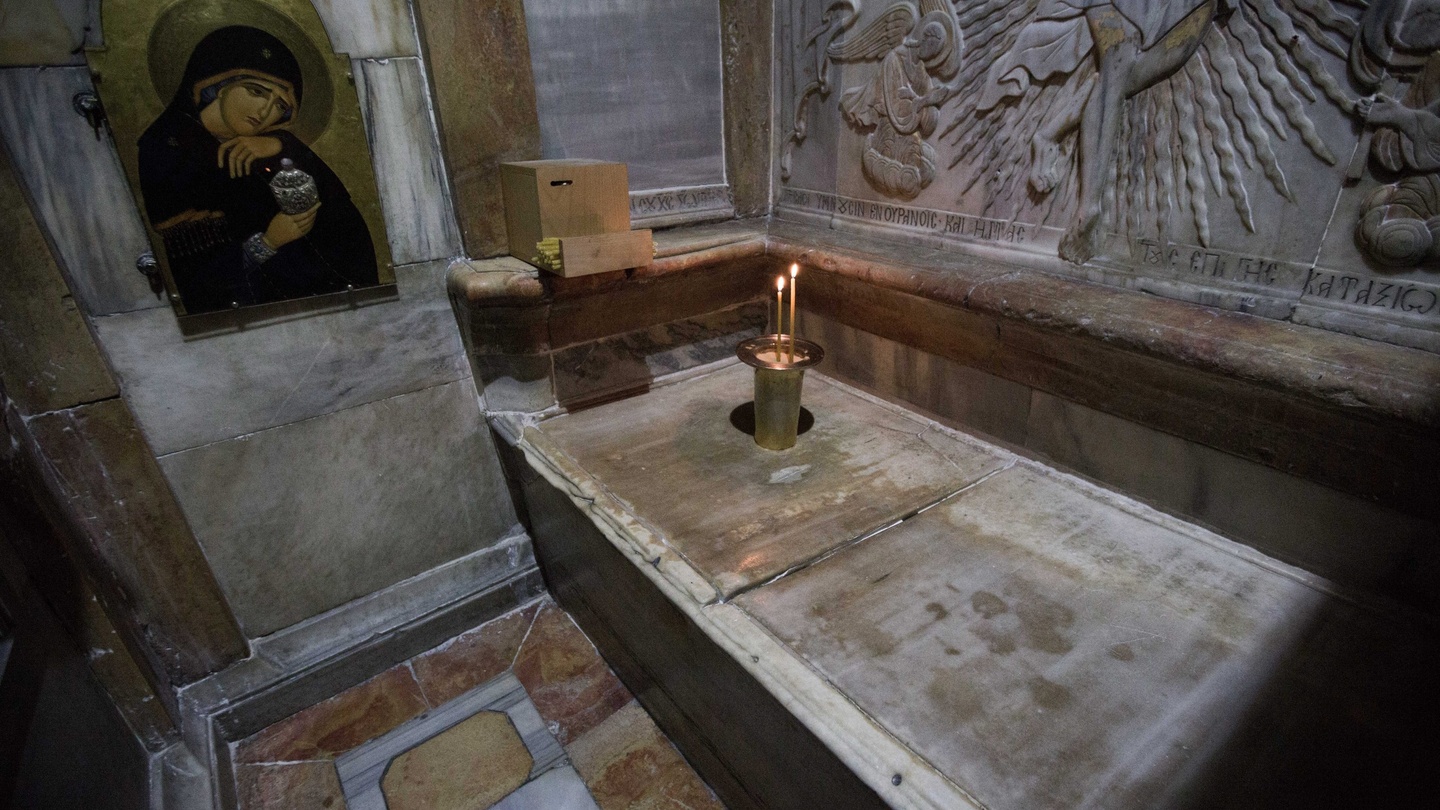
Image result for photograph of the tomb in the Church of the Holy Sepulchre

And, I did get to light that candle in memory of my mother, third one from the left.  


And so, this was our first full day. I was exhausted after it, but full of wonder. I am exhausted after writing about it, and excerpting some photos. But I feel the wonder again. 

Sunday, December 9, 2018

The Delightful Dust of My "Israel Shoes"

I bought these shoes specifically for the trip to Israel I signed up for a few months ago.


The idea, of course, was comfort, and grip. I knew there would be cobblestone, uneven surfaces and hills. I would be prepared with a broken in pair of Skechers.

It was not always sure that the Skechers would make it to Israel. You see, as a healthy number of my friends and family know, I despise flying. I have done it. People might not even believe I do have a near overwhelming fear as I have been back and forth to the East Coast many times since I first moved to Los Angeles. Before this last scheduled trip, to be from November 23rd to December 3rd, I had also been to Europe, twice, some 12 years between each sojourn. But I have testimony. There are people who have flown with me, who know how I feel about it, and the agitation I can manifest to a seat mate. It is just one of my many life's anxieties, and I have always been aware of how much it limits me. Still, it has always been a hard psychological nut to crack.

Yes, I know. It is safer than driving. My mind agrees. My imagination however goes on crazy time.
It isn't about dying per se. It's about the how, should there be some catastrophe while I am a paying prisoner in a tin can 9 to 10 miles in the atmosphere, travelling at 500 or more miles per hour, the end would surely come. I won't delineate the particular scenarios that graphically play out in my head. And my concomitant fear is that what I will say during whatever the scenario will not be a holy prayer, which, I have to tell you, is of great concern to me, as much as the horrible manner of death part.

Anyway, a year ago or so, some of my St. Victor friends and I were talking about going together on a trip to the Holy Land. And then around the early summer of this year, I started getting e-mail from the Abbey of St. Andrew in the Mojave Desert to which I have some occasional connection about a Pilgrimage to the key sites of Christianity (and Judaism) in Israel with one of the Priests from that Monastery. The Abbey sent it fairly frequently. I looked at the Itinery and thought, "Maybe". And then I thought, "how far is it to Israel by plane?"  If from Los Angeles directly it is 7,605 miles. If you do the Los Angeles to Newark and then Newark to Tel Aviv, which this would be, it is, a whopping 8,167 miles. "Maybe" became "not a chance" and I deleted the e-mails.

When I was at Mass, though, and lectored, and heard the Gospel, I sensed a kind of beckoning. It wasn't anything dramatic. No voices--you will be happy to know.  I was back to "maybe". As it came time to sign up for the trip, which was in about August, I told myself, "If I get another e-mail from St. Andrew's Abbey, I will sign up".

And so it went. An e-mail arrived and I paid to take a trip to someplace I really wanted to go with all my heart. As long as November was two to three months off, I could dismiss, sort of, the thought. I bought the shoes. I wore them around, calling them, to myself at this point, my "Israel shoes".  They were well fitting, and bouncy. And secure on all surfaces, even water sprayed. These shoes would walk where the ancient Israelites did. They would walk on the streets of Old Jerusalem, where Jesus walked and through which He was marched on His way to Calvary.

As the time drew near, I foundered. I very nearly simply cancelled, and would readily forfeit the substantial sum I had already paid. And then I would be at Mass, helping the priest, looking at the San Damiano Cross above the Tabernacle, and the fear, though never eradicated, was muted. I can't say there were words, but there was a "You must go" certainty.

One friend had suggested hypnosis, and I looked at several websites. I have tried medication on one or two occasions, but they don't do the trick so I didn't seek anything.  I was entered onto a prayer list or two, by those who know my fear. Perhaps that was the dispositive factor. I don't know. But I didn't cancel. Even when, a week or so before the trip, there was a lobbing of rockets from the Gaza strip. I had the perfect excuse, but after talking with the head of the travel agency that arranged the whole thing--who had been there before, I didn't use THAT excuse--even if now I added rockets to my airplane fear scenario. At least that would be quick.

I put on my "Israel shoes", gritted my teeth, and flew. It's 14 hours going, those two flights. It's 17 hours coming back, the two flights (a different flight path). The blessing was that while there was some turbulence in both directions, it was fairly rare and of short duration. As to me, while people slept around me, I was exhausted but steadfastly awake. It always seems to happen that whenever I think I am about to doze, that little sign with the fastened seat belts goes on. On one or two of the flights, a couple of tour companions were next to me. We introduced ourselves. We chatted a little. One suggested we do the rosary together. I can't concentrate on anything when I am flying; alas, not even prayer (well truth be told eve when I am on the ground I am an antsy pray-er). I mindlessly watched movies or documentaries I had already seen. I thought that there was a little bit of Purgatory here. What I mean is that Purgatory is a place you go for purification, but you know that you will be in heaven afterwards. I knew that if I got through this I would be in this magical place of History, Archeology and Theology. It was worth the pain I said to myself. I did't eat anything, though they provide meals twice on these transatlantic flights. I sipped water or soda. No worries there as I could afford to lose a pound or 50.

And then I was landing at Ben Gurion airport in Israel, and driven with strangers who would become companions in mere days,perhaps, now, some friends, to our hotel in Jerusalem, where we would, the next day, meet our tour guide Doron and be safe in the hands of our driver Badi. Me, and my "Israel shoes" were off! I will write about the many places I walked with my fellow pilgrims in upcoming entries, of ancient streets and mountains filled with stories of lives long gone but now part of my own. There is much dust on my shoes from Mounts like Carmel, and Tabor, Olives, and of the Beatitudes. And the almost impregnable Masada which had fascinated me for many years. And, even now, I can still see a shadow of some mud from the shores of the Sea of Galilee.

If I had not walked with these shoes where He walked and where saints, known and unknown, because of my fear; if I had not gathered the delightful dust of salvation history on my shoes, it would have been a kind of tragedy. I have received a spiritual, and emotional fueling, the significance of which remains to be fully experienced. I have heard people say that the experience of going to the Holy Land transforms the traveler.  I believe it, but I didn't want that possibility to be a source of anxiety, in other words, that I was expecting transformation, or acting as if I had control over what I would feel or not feel about the experience. If this experience has "changed" me, I am not sure how, yet. Will it make me a better Catholic? Or a better person? I don't know.  But I feel something, good happened to me when I put on the shoes and this time, this time, did not allow my ever present fear to inhibit me. I am just going to let it be. I suppose that itself is a small miracle.


Tuesday, November 6, 2018

Wittier than Dorothy Parker


Image result for can you ever forgive me photos


Lee Israel was a writer of celebrity biographies who fell on hard times. She turned to a creative form of crime to make ends meet, forging letters of famous writers as collectibles.

"Can You Ever Forgive Me?" based on a memoir by the late Ms. Israel that frankly I had never heard of (not that this fact means anything, except that I usually latch onto tales like this combining a little bit of entertainment with a lot of angst) is a movie that satisfied the existential in me, the "what's it all about" gene that I probably share with millions of others. I wasn't sure it would be so, though the summaries of the story were compelling, because I am not usually a big fan of the actress who portrays Ms. Israel, Melissa McCarthy.

Apparently Ms. Israel, even when she had marginal success, was a difficult person. She didn't bow to any authority, her public, her critics or the agent that could get her contracts.  She had few, if no, friends. She did have a cat. She loved cats more than people.  She was lousy at relationships. Her former lover (played in the movie by Anna Deavere Smith) cannot be attracted back into Israel's life when trouble (the law) begins to pursue her, because Israel is unable to let anyone close. More than that, being so difficult a person, let's just say, "complex", she affirmatively pushes people away.

It is after selling a legitimate letter sent to her by one of her subjects of the 1970s, Katherine Hepburn, that Israel realizes she can recreate the letters of others, Noel Coward, and Dorothy Parker, a bit of a difficult lady herself in her time, make money by selling them to collectors, and indulge her creative side, which has been cruelly quelched. Her apartment becomes a store-room of typewriters of every writing generation. And she either traces or expertly copies the signatures. After a while, she creates forgeries from archives and replaces them with some of her copies. She was prodigious. If I recall, she did about 400 of these letters, two of which actually ended up in a book about Noel Coward, until the fraud was discovered.

Broken attracts broken, I suppose, and she manages to attract a man named Jack Hock into her life, not as a relationship--they are both gay--but as a kind of accomplice. Jack drinks, smokes and carouses, a path that will ultimately kill him as so often it does--and he is not exactly a reliable partner in crime. Oh, and he kills her cat, Jersey, accidentally.

She gets caught, of course. Jack snitches after using her apartment as a love nest while Israel is away at an archive in pursuit of her complete downfall.

One of the letters ends up in an antiquarian shop, and, during her probation, she inquires of the owner what is the price to buy it. The forgery, having been "authenticated" by "experts", is for sale at an exquisite price commensurable with authentication.

It is so wonderful. One wants it to have been by Dorothy Parker.

"Alan told me to write and apologize.  So I am doing that now, while he dresses our Turkey dinner with the boys across the road.  I have a hangover that is a real museum piece.  I'm sure then that I must have said something terrible.  To save me this kind of exertion in the future, I am thinking of having little letters runoff (sic) saying 'Can you ever forgive me?'  Dorothy.

Can you ever forgive me?"

Though initially dismissed by the elitist letter seller, Lee Israel proves to him that it is indeed a fake. He thinks about taking it out of its prominent window space with its prominent price. Then he puts it back.

Though required to abstain from alcohol, Israel returns to her favorite bar, where she meets up with the now sick, and still full of the glories of the life he still fantasies to have had.  Israel has a new idea. She will write a memoir about the caper. Jack agrees to be in the memoir (although apparently Israel didn't write much about his specific part in the events). They part the strangers they have always remained, to each other, to themselves.

Lee Israel goes back to her apartment on Riverside Drive in New York. She gets a kitten.

I really liked this movie. I really liked the performances of McCarthy, and Richard E. Grant as Jack. I liked this movie because I saw real people in the characters. I got lost in them. It's rare that that happens when watching a movie these days.

I recommend it, for whatever that is worth. Here's the thing too. I think I kind of sympathize with Lee Israel's broken road of creativity. And I far too often like cats more than people.                                                                                                 


Friday, November 2, 2018

A Tree Dies (is Killed) in West Hollywood or Nothing of this World Lasts

As I begin this entry--which I will conclude later in the day after my errands are run--the sawing that began outside my bedroom window nearly three hours ago continues. I have resigned myself--with great difficulty--to the fact that the tree which gave me privacy, and comfort, made me feel as if I were a child in a leafy house, might soon be no more.

I was hoping, futilely, that the workers, shouting at one another incessantly for reasons that aren't clear to me, would only trim the few long dead branches. But after a fearful peek outside my blinds, I see that the noble tree is being slowly dismantled.

For now, I take my leave to get ready for the rest of my day. When I return to these pages to complete this entry, where once there was a piece of the life of nature, there could be a barren space.

🕔🕓🕕🕖🕘🕚  AND TIME PASSED. . . .

I have waited until the day after the sawing to complete this entry. I was terrified that the workers would be back to eradicate the foundation of the tree. They were back, but only to trim a few branches of the adjacent orange tree and complete some other unrelated tasks. But here's what happened.

Upon my return in the late afternoon, the saws were still whirring, and I hesitantly lifted my blinds to see what was the outcome. Later, as the workers loaded up the trucks with the once mighty branches of the old tree, I saw a couple of creatures surveying the scene. One appeared to be a Bluebird, and it seemed she was searching for something, no doubt a nest that had long since been destroyed, though I hoped I was wrong. And a baby squirrel leapt onto one of the sheared branches and ran down the trunk.


It looked pretty bad, but I have seen cutting decimation before and the tree has come back. And it occurred to me that the owner of the building wouldn't want to spend the money to completely uproot the trunk and the roots, and that made me happy.


Change. I am not alone in hating it. And that's all that is around us. Change. This tree is just a small thing. But I have worried since the fire that nearly claimed the apartment next door that the tree's days were numbered. And yesterday--now it is yesterday--I held my breath and tried not to become a full depressive at the idea that what I considered a special feature of my little dwelling would be just another aspect of the past. Actually I was trying not to be angry about it, and about the men, mere working men, so gleefully (it seemed to me) wreaking havoc on nature.

Used to be, through the spring and summer, that the branches and leaves filled the length and width of my window. It will be a long time before that happens again.

I try to accept that things, and people, don't last. Me either when it comes to that. It is the nature of existence. But as I am getting older, oddly, I am more rebellious about it. Perhaps that is also the nature of existence. The good side of the awareness of the transience of things and people upon which I have come to rely is the motivation to garner experience in a way that frankly, in a foolish effort to be safe, I avoided for the first two thirds of my life.

The great thing in the immediate circle of my little apartment. The tree wasn't killed. It is still there. It did need pruning, and while the effort may have been ruthless, it was not a coup de grace. If rain comes and gives the roots some sustenance, in the Spring new branches and leaves will begin to grow. In no time, the tree will be back to its fullness. I will enjoy it again.