Saturday, October 20, 2018

The Watch- by Constantine Gochis


Image result for stopped watch


I am cleaning up my desk after a difficult week. Something about the re-organization always helps me after a bad patch. And, as I was doing so today I ran across this story.

I hope this one is pure fiction because the denouement of the narrator's conduct is, at best, troubling, but at worst a moral wrong. Maybe it's really somewhere in between as the world then, in World War II, and now, in the age of accusation devoid of empathy or a search for truth, has always been such a burden punctuated by too short moments of joy. It wears even the best among us.


THE WATCH

The letter came to me in Naples.  It was written on the familiar chemically treated paper provided for use by enemy prisoners of war.  

I had no immediate recollection of any prisoners with whom I had sufficient personal contact to warrant their writing to me.  I looked at the return address.

The name was Junichiro Matsuo.  There was immediate recognition. He was the Japanese envoy from Latvia, the one who had a Polish wife, she with a look of imperial arrogance.

I remembered the night of the emergency call.  

"You will be receiving a cortege of middle level enemy prisoners. They are diplomatic enemy attaches, refugees from the advancing Soviet troops.  Treat them with kid gloves."  So said the voice.

I resented the call.  I had no feelings of charity, of compassion, or forgiveness for the new arrivals.  True, they were not the immediate executioners of innocent millions, not the ones who pulled the triggers and wielded the bayonets; but they were the channels through which death and desolation became the order of the day.  The retribution was:  "Treat the with kid gloves."

There was no contrition that I observed, no guilt.  They demanded the treatment civilized nations allow the enemy, though thy came from a cause that destroyed any vestige of civilization.  They knew the Geneva Convention.

Junichiro wanted a bath to remove the dust of his retreat from the vengeance of the Russian troops.  

We provided a bathtub taken from a building that once was, and his Polish wife, now dutifully Japanese, scrubbed him clean.

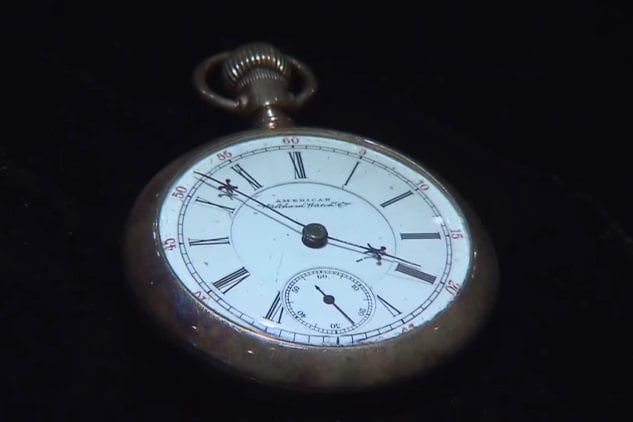
He asked for more.  He produced a watch and chain, a complex looking mechanism with several dials and minute hands that were stilled by a usually inexorable Time, something he called a Chronometer, a term I had not heard before.

"Honorable, sir," he said, "the watch does not function.  Perhaps you will see to its repair?"

I took the watch without comment and placed it in my pocket.  

The following day, the orders changed.

"Proceed as if they are ordinary prisoners."

Thus, they were processed, searched, divested of property of military meaning, and sent to appropriate compounds.  Such are the winds of conflict.  I saw no more of them, or heard, until this stained letter arrived, sent some months ago.  It began:

"Honorable Sir, I lose much face before my father.  I do not preserve the one thing he gave me that he had to give, the watch which I trust with you for repair."

I put the letter down and searched my various pockets.  There it was, the little hands as still as they were when he gave it to me.  My intention then was not to attempt a repair as he asked. I am sure I gave it little thought.  Now, it occurred to me I would not give it back, even if I could.

I remembered another watch, not as elaborate as this one, suspended with an ordinary chain, that the Chaplain removed from the body of a boy on a lonely Italian hill. There were some cigarettes also, for which the departed had no further use.  The Chaplain offered the crumpled package to some of us.

"Boys, there's nothing wrong with the cigarettes, take them."

We did not.  There was the initial fear of ultimate contagion.  It was our first encounter with death.

The letter spoke also of Death.

"My father was dying when he gave me the watch. He said, 'this is all I have to give, as I have failed in life.  It is all I leave you to bestow, in turn, on your son.'"

There is no place, I thought, for sentiments of this kind.  There are human impulses in a world only half human.  I was not moved to pity.  If I had any tears, they would go to the dead boy on the  hill whose father and mother would receive, among other effects, the watch with the ordinary chain.

There was no more I wanted to read.  I took the watch and held it by the ornate chain.  The motionless hands were fixed on the Roman numeral twelve.  It could not have been noon when they ceased their journey.  It was the season of midnight and darkness in the world.  I swung the watch in an arc and dashed it on the ground.  I felt a tear descending on my cheek.  I allowed it to make its way where such errant drops are wont to go.

Friday, September 21, 2018

Thad Mumford: A Personal Reflection


Image result for Photos of Thad Mumford

Reaching for long ago and probably not always accurately chronological memories in my mind, it was in the 8th or 9th year of M*A*S*H, the wildly successful comedy/dramedy about a medical unit during the Korean War, that I first met Thad. It was, for sure, the late 1970s. I was in law school, in New York, but made my second trip in 1978 to Los Angeles, having fallen in love with it the year before during the first visit. I had formed the idea of being an attorney very early, when I was about 14, for reasons that, frankly, still elude me now that I am retired from practice. But a sojourn at my college radio station, WFUV, Fordham University, had me hankering for one of two different roads.  Either I wanted to be an on air talent, or courtesy of a half-hour radio sitcom a fellow student, Len Klatt, produced, wrote and directed, (surprise of surprises as I had never harbored the desire before junior year of college) a television writer. So, before law school I worked at a local New York radio station behind the scenes, and almost got a job as a rip and read newscaster at another local station in Lakewood, New Jersey, until my father's impassioned logic (yes, there is such a thing!) convinced me that I ought to seek a more linear career. That didn't mean I couldn't pursue the writing thing, and by the end of my college experience in 1976, Len and I had become writing partners.

The enterprising Len had discovered that Thad was a former student at Fordham University, our Alma Mater, and also the Alma Mater of Alan Alda, the star of  M*A*S*H. The former was only three years or so ahead of us.  At some point, Thad actually read one of our speculation scripts and sent an enormously encouraging letter. And I suppose it is at that moment, I mark the beginning of a 40 year friendship.

Len had already met Thad in 1977 during a trip to Los Angeles. During a joint vacation trip with Len to Los Angeles in 1978, I had my chance. My memory is vague where I was introduced exactly--I think it was before or during my first visit to a television studio, Twentieth Century Fox to let Len and I see the set, and introduce us to a few of the cast members. I have three impressions of the introduction, rather than memory.

The first was that Thad had an amazing handshake. It was strong, and sustained. I always liked good handshakes. There's nothing like someone seeming glad to meet you that inspires confidence, someone who has an energy. The second was his casual/not casual dress, a polo shirt under a well tailored hounds tooth jacket. Like many of his friends, I would later learn that Brooks Brothers was his primary, if not sole, haberdasher. I am certain that a few years ago, when we had dinner, he was wearing the very same jacket, or one of its later iterations. The third was that I found him incredibly attractive. It was many years later that I admitted that to very few friends. And it always remained the case though I never revealed it to Thad. There was something dangerous about Thad. And the one thing I never have done in my life, particularly as to relationships, is dangerous. But that didn't mean I wasn't attracted to it. And couldn't be a friend.

Oh, I suppose there was a fourth thing as I recall riding in the back seat of Thad's BMW on the way, perhaps, to the studio where we got that great tour, met Loretta Swit, and Harry Morgan, and Alan Alda, and watched a scene being filmed.  I was feeling a little embarrassed. I was still in law school and living at home, driving my Dad's Pontiac Volare, on rare occasion when I drove at all. Here was this guy just a few years older than me and he had already been a writer for more than a few television shows. I mean he had done an episode of ROOTS, an historic mini-series. And there had been the Electric Company. And then, pun intended, there was Maude. I had maybe 4,000 dollars in the bank, and I was still in school, and a neophyte writer, if the fates allowed.  This guy took risks. I didn't know if ever I would take such a risk to forego a regular job for a creative life. No, I knew. Unless the winds of chance blew a major, and blatant, opportunity, my way, I was going to take the safer route.

Well, I shouldn't have been so hard on myself I suppose, for I did take a risk of sorts, in 1981, and moved to Los Angeles hoping to get a job in the law (once I got my law license there as well as in New York) while continuing to write with Len, who still lived in New York. Both of us had remained in touch with Thad, but in different ways, and in different intensities. To say that Thad was a sports fan would be to understate his passion. He had not only been a bat boy for the Yankees, the genesis of which I used to, and I am sure many others who cared for him felt was a key part of an autobiography he should have written (an a biography someone I hope will consider), but hockey was life's blood to him as well, the Kings his team. That wasn't an area in which I excelled in conversation, but Len did. Hockey was a sport that he not only liked, but himself played, well into this decade. When he stayed with me, for about a week, during a transition in his living quarters, his hockey bag and skates and sticks dominated my small apartment. His knees were in pain, but his soul soared when he played, even if he spent the evening with an ice pack to reduce swelling.

In 1982, when Len was visiting Los Angeles, and MASH was wrapping up its run, Thad invited us to his gorgeous little house in Burbank to watch "Goodbye, Farewell and Amen". That is at least what I remember.  His girlfriend at the time, and for my money, the love of his life, Roz Doyle, who would be a producer for WINGS (and the inspiration for the character name on Frasier) until her too early death in 1991, padded around while Thad offered his thoughts on the last episode.

Swatches of time passed. Months. Years. He moved around. Martha's Vineyard. Washington, where he grew up. Places of which I have no idea. Back to Los Angeles as he did other series. The man was a prolific creative force. Len would hear from him; they'd see each other when Thad was in New York.

In the meantime, writing as a focus became impossible with my various jobs, first as a secretary while I passed the California Bar, then as an attorney with a single practitioner, then as a prosecutor for the State Bar. Safe had beckoned and I had gone to her. And something about having become friends with Thad meant never asking him to pull any strings for us.

Over the years, I learned a lot about his life, and despite his persistence in getting into the business  how unsure he was of his palpable, manifest talent, and seemingly unaware of just how BIG his successes had been. I think he would be surprised just how significant he is considered to have been in the entertainment industry, now that he is gone. The obituaries correctly view him as a pioneer. My critique of the industry that gives him homage after his passing is that they weren't quite as solicitous about jobs for a more mature member of the writing community, which he had become. Though I am an outsider to the industry, I have observed that the "old time" writers have difficulty competing with the young firebrands who know very little but think they know everything.

He seemed not to have faith in his own intelligence though the proof of it was in print and on the networks and beyond. But he persisted. He had many stories left to write. Lots of them were about baseball and some of the old timers he had known. I remember meeting him for some lunch or dinner in one of his apartments while he regaled me with an escalating enthusiasm punctuated by his explosive laughter with another tale I had not heard. I would glance at his writing desk, perfectly organized, with equally sharpened pencils (Thad was not a fan of on screen writing--he was contemptuous of anything technological-- though ultimately he had to make some concessions), and index cards with incredibly neatly printed short ideas. I kept telling him to write his autobiography, this son of a teacher and a dentist, who had become a Yankee Bat Boy, written jokes for Johnny Carson and Joan Rivers, was on staff with the Electric Company, a PBS fun but educational children's show, all while he was in his 20s, who fell in love with the famous and not so famous, who was on staff or producing a bevy of the golden shows of the 70s, 80s and 90s.

He was complex, mercurial--the kind of person to whom I am often drawn-but that didn't always make it easy to be his friend.  He could push you away. Then he'd draw you back. When he was on his game, he could be charming, and conversation with him could lead to an engaging several hours. He charmed even my curmudgeonly father, with whom he shared a Thanksgiving dinner one year. Among his favorite haunts for those type of evenings was Peppone's in Brentwood. He liked the old style restaurants, the ones with the enveloping circular booths and candles and waiters a century old.

Our last conversation as of old was not at Peppone's but at the Smoke House in Burbank in March or April. Was it possible that I had known him so long? It seemed like yesterday. Everything seems like yesterday at this stage.  In the last few years, so many who have been threads in the tapestry of my life have died.

The last brief call was just before he went home to see his sick, elderly father in Washington. I think that was early August.  He was just letting me know he was going. We'd talk when he got back. His father died on August 16.

I got a text from Len on September 15. He happened to see on the net that Thad had died, apparently on September 6, only a few weeks after his father.

Thad would not be coming back.

Things sort of just suspended. Another thread, a big one, from the tapestry. I thought, "He didn't get to write his autobiography."  And then I cried for a while.


Thursday, September 13, 2018

Oh, the Pain!

Image result for Dr. zachary smith

I suspect I looked a great deal like Dr. Zachary Smith over this last weekend. A long since crowned tooth that purportedly had a root canal some 15, 20, or 30 years ago--I don't know when--suddenly sprang into full throb torture. It started on Friday or Saturday last, but with it being the weekend, and my having a yard sale long planned with a friend that could not be put off, the best I could do to address its early and not completely unbearable stage was to chew aspirin. I'd get a couple of hours before I needed more. And I knew I had to be careful on that score not to kill my stomach in the process of addressing the pain in my tooth.

By Monday morning, I realized that though I am a follower of a faith for which a Theology of  Suffering is a major tenet, I was failing the course. I had wended my way into "big wimp" territory. There were beginning to be tears. I held off on the gnashing of teeth as that would only cause more pain!

I called my newest dentist who is in the locale of my two former dentists and begged for an appointment which could not be managed till 3 p.m. I knew it was unlikely any actual work could be done on the tooth, but I was counting on something to address the pain and what I was sure was a whopper of an infection. You see, I am ashamed to say, that I have had a lot of dental work in my life.  I have had several implants after one or two of the roots on crowned teeth broke irreparably. Though I regularly brush, I have not been a perfect flosser. In fact, truth be told, I probably haven't been an imperfect one. But anyway, I have had enough work to know when there is an infection.

X ray. Yep. Infection. Antibiotic. And a painkiller, something a little dicey, Hydrocodone with acetaminophen. And an appointment on Wednesday. I had high hopes for the Hydrocodone as I began the antibiotic. It is supposedly the strongest type of painkiller. And alas, it only took the edge off for about a half hour in any given dose. Smart enough I that I didn't double down. And so Tuesday was a marathon to getting to Wednesday.

And so it began at 9 a.m. Wednesday. The sawing off (that's what it sounded like; not sure I'll get that one back if the re-treatment works; that's what they call it when they try to do a second root canal on one that was not sufficient) of the crown. This was after, of course, an abundance of pricks by a very sharp needle to deliver pain killing salvation to me aching mouth. And then the digging into the old cavern of my previously rooted canals. I had the thought that the inside of my tooth was not unlike the tombs of the ancient Egyptians--never meant to have anyone clawing about once they had been sealed.  But then, there they were, the instruments of excavation. At first, there was no pain, just the sounds and vibrations of the equipment motors.

And then I was feeling something. It wasn't the throbbing per se. It was a building ache. From somewhere. It was hard to intercept the drilling dentist with the rubber damn on my face. But I mumbled, "I'm feeling something." It was some of the infection. And as she digged deeper, there was an exquisite sharp pain. "There shouldn't be any pain!" I thought. I was numbed to the nth degree.
But there it was. And I sang a scream. And then there was relief as something building up had been released. It happened several times. "Are you in a choir?" asked one of the assistants. I was. I had forced my scream into a sing song to avoid any expletives. Interesting that I even thought to do that.

"Everything's ok back here!" shouted the various folks attending me to the patients in other rooms. I laughed loudly. Now, I hoped, they would believe it, my fellow sufferers in chairs outside of my sight.

But there would be no re-treatment this day said my dentist. Too much infection. We have to have the rest of it drain, and I was prescribed a second antibiotic to be taken with the first, as they apparently have different targets. And another painkiller, hopefully more effective than the first, which I have already retired. Because of the digging about in my tooth, some of the infection had kind of bunched up into a swelling on my cheek/jaw. The pain was not gone, but it was greatly abated. That was enough for me given the intensity of the prior several days.  An appointment again, next week.

Tonight. The swelling is less, though not gone. I have been assured that by the end of 72 hours it will be more or less gone. There is something exhilarating about the absence of pain. I look forward to it.

Oh, the pain. I am glad it is nearly gone!


Monday, September 3, 2018

Be Not Afraid, Stand Firm

"From some fissure the smoke of Satan has entered the Temple of God. . ."  Paul VI, 1972

It's not the first time, of course. That as Paul VI pointed out in his prophetic words, was in the Garden of Eden. God spoke His terms of love. Adam and Eve had all they needed, but they would not obey one directive and sought divinity on their terms, rejecting the Divinity which created them. God makes covenant with His Creatures. He has made made covenants over and over since that fateful and willful choice of mankind to take the knowledge of good and evil and attempt to usurp and deceive the Creator. And then, finally, He sent Salvation itself. He gave us the Church and told us what we needed to do. He laid Hands on the Apostles and they, given authority under God, laid hands on men for two thousand years to be our teachers, our preachers, and those consecrated to be the instrument for the Presence of the Eucharist, which Catholics believe IS God Himself giving us Grace to do His Will.
s
Pope Paul VI called it "the smoke of Satan".  In his disguise as a snake, Satan merely talks to Eve. He tells her that something is good--pleasurable, a special knowledge--which is not good for her, or for her husband. His message is kind of the original "Why not?". No need for limitation, though of course, humans are limited. No need for obedience. Who is this God anyway, telling you what to do? And He probably doesn't mean it anyway. Satan insinuates. He cajoles. And Eve begins to see no obligation to obey, in love. And then Eve insinuates, quietly, her husband. And then, well, "All hell breaks loose!"

Somehow, in a disguise of unimpeded modernity, convincing man of a unilateral power he can never have, Satan directed his smoke not only at the laity of the Church--half of whom routinely dismiss the precepts of the Church which have never changed--but at those who were consecrated as representatives of Christ, those who were given the authority to bind and loose. I can only imagine what it was like when he did his dirty work from and after the beginning of time, but I will tell you, it must have felt like the smoke after a fire thrower was unleashed. Because that's what it feels like now.

Some of them didn't just sin--which all of us do even though today we don't acknowledge that such a quaint idea--they did so in some cases while committing soul murder on innocents or on those who were otherwise vulnerable. I know they are a small portion of those who are otherwise selfless and like you and me trying to live by God's laws. But they have given Satan quite a lot to insinuate now.
"Well, look at your priests and bishops. While you were struggling with the what they told you were God's sayings, they knew that none of it was true. They were having parties and unbridled pleasure and nothing happened to them. Nothing is going to happen to them. You might as well just give up this Church thing. It has no meaning. There is only now. There is no eternity."

What these men did makes us so angry. It should. Leaving makes sense, no?

It makes sense if I don't believe in the heart of the teachings. If I believe that God is in the Transubstantiated Host and if I believe that God offers us, with the help of the Church's teachings, an individual choice to accept the Salvation offered by the Cross and Resurrection, then to leave is spiritual suicide.

The history of mankind and his relationship with God, inside and outside the Catholic Church, has been a see saw of faith and faithlessness. To say that I am leaving the Church because of the sins of men and women is to pretend that somewhere there are men and women that don't sin. In fact, I go to the Church because I believe what some think is a cliche, that it is a hospital for sinners. Some of us get better. Some of us do not. But if not there, where shall I go?

Either I believe the Truth is in the heart of Catholicism, or I don't. It looked pretty dark when Christ was crucified. Many people, who had followed Him, walked away from His teachings. Some did not.

It has always been hard not to be afraid and to stand firm. It's no different now than it was 2000 years ago. I don't want to be one who walks. I pray not to be afraid. And to stand firm.


Image result for Be not afraid, Bible


Tuesday, July 31, 2018

"Slominsky" A Dad Story

This is a very short one. And I am sure true for Dad used to help the men and women around his apartment, a haven for the elderly. This took place in the days before cell phones, clearly, when you had to find a place to call, a booth, a business. Dad was probably older than the woman he helped as it turns out.


She was diminutive and old, very old. 

She handed me a badly rumpled piece of paper on which there was an almost illegible address and telephone number.  I could not help.  She was about to leave, a pitiful figure, distraught, the translucent skin on her face allowing wide red blotches to come through--perhaps because of the unusually cold snap, or perhaps a physical problem.  I stopped her.  "Why don't we call," I suggested. She looked about in total distress. 

"Where?" she asked, looking about.  There are no phone booths on Fairfax Avenue.  Generally, these accommodations are abundant in areas where the young men array themselves, listening for the beckoning sound of their state of the art beepers.  I led her into the Wells Fargo Bank and solicited one of the Assistant Managers seated behind a desk.  He assented, and I called the number, and handed her the phone.  The accent was strong, but her English was fluent.  "The name is Slominsky.  I'm looking for a cousin of the same name, and I was given this address.  Is there some way you can come to me?" There seemed to be a difficulty.  I took the phone, introduced myself as a passerby trying to assist, describing the lady as old, "perhaps eighty or eighty-five."

"I'm sixty-five," she corrected.

"Where can I reach her," said the woman on he phone.  I solicited the information and reported, "The Shalom Home" and gave the address, familiar to me since I live in an adjoining building. 

"It's not that far," said the woman.  "Tell her I'll call her later this afternoon."

Outside, I dared to inquire further on the matter, despite the cardinal error I had already made in estimating her age as eighty or eighty-five.  On further examination, in the light of a noon California sun, I privately thought the guess an underevaluation. 

"Are you Russian?" I asked, the most frequent background of the elderly in this area these days.

"Lithuanian," she replied.  Further probing revealed that she had taught school in Boston and New York, that the Slominsky she was seeking was "a great writer" who she last saw in Lithuania years ago. He was one hundred and one years old.

I asked what he had written. She handed me an article from an unidentified newspaper, which she quickly retrieved before I could read it.  Nevertheless, I had caught part of the headline, "Slominsky 101. . . ". The rest I cannot swear to, but I caught the words, "Writer, Musician."  It was a lengthy article. Clearly Slominsky was still alive. Yesterday, George Burns reached 100.  What can I say?

I suppose "Mazeltov" is as succinct as I can put it.

Thursday, July 12, 2018

Colorama and the Stork Photo Studios--A Fragment of Days Long Gone By


When I was a kid, the only time I ventured into Brooklyn, was when my father took me to his office, a photography plant at 115 Myrtle Avenue, known as "Colorama", a part of Stork Photo Studios.


I have vague memories of the interior; none of the exterior.  I was given something like 25 cents to stamp envelopes with postage, or names or something, I don't remember which, and sometimes I helped with the stock room. I used to love to watch the ladies--they were always ladies--in the color room. This was the days before color photography and color meant quite literally, people with cotton balls and q-tips giving a patina of the rainbow to baby faces in a windowless room. Thinking of that time from today's perspective, it is pretty pre-Flood stuff. 

By the time I was going there, Dad had been there since just after World War II, so I am guessing close to 20 years. He sure looks like someone important in the Mad Men suit. I didn't know what he did there. But he seemed pretty important, and it was all right for me to be there, helping or sitting in the dingy conference room with a coke machine that brought out the kinds of bottles that are kitsch today.  


On the other hand, there is something disconcerting that he was categorized with "Some of the People You Never See". I understand though. He wasn't a salesman, so he wouldn't be seen by the parents of the children seeking (or being pressured into)  wallet size shots and plates covered with their children's faces (yes, they put you on a plate; I still have one of mine).  


The "President" was Charlie Shapiro, here calling himself Charlie Sharp, for reasons no doubt related to the reality of prejudice that hamper human nature.  I am assuming this publicity handout was done sometime in the 1950s, as it refers to a car from 1954, that might be a used car--I can't tell.  But one thing is true; this is all I have that is tangible of the place. I know it went out of business around 1965, because my father, then getting close to fifty years of age, had to start looking for a new career. I also know that the original building is gone--at least according to my Google Search, replaced by something shinier in 2002.  

As places, and people, seem to flicker into the past, I find myself ever more nostalgic. 

The modern gnostics will tell you that those days were not good; that now, with all the nasty bickering and posturing, is better, more enlightened. There was, I keep hearing, nothing good about the good old days. 

It was imperfect, because people were imperfect; evils were done.  Evils have been done since the day Adam and Eve got kicked out of Paradise. And though--as many of us believe, but clearly fewer and fewer than in those days gone by--we have had our relationship to God restored--now mankind has to decide to accept that relationship instead of deeming itself a godhead.  It's not looking good.

Personally, I am not that crazy about the times in which we are living. I sound like my father. I suppose it comes to all of us. 


Sunday, July 8, 2018

Three Identical Strangers: Food for (Moral) Thought

Eddy Galland, David Kellman and Bobby Shafran, identical triplets who were separated at birth and reunited at age 19. Photo: NEON

I don't know why I don't remember the early incarnation of the story of these three young men from New York in about 1980. I mean, I was still living in the State, but perhaps, just out of law school and newly licensed, looking for a job, I was so pre-occupied, and I just missed it. Three boys, identical triplets, had each been adopted by different families. Though they each knew they were adopted, they had no idea, nor did their parents, that they had siblings.

SPOILERS AHEAD.

Nor, as it turns out, were they or their adoptive parents told they were part of a troubling, and still largely secret, experiment about nature versus nurture.

It all started out looking like it would have a happy ending. Robert goes to his first day of class at a community college in Sullivan County, New York. Everyone seems to know him. Everyone calls him "Eddy". This Eddy would be a sophomore, except one of Eddy's friends knows that Eddy isn't coming back to school and that this newbie isn't Eddy. But physically, he is his doppelganger.  He figures right away, he must be Eddy's twin. Robert and Eddy are introduced, and, unbelievably, the story of the twins runs in the New York papers and reveals, a third boy, David.

Identical? Yes. And no. One, seems to me was shorter than the others. And although features were much the same, as you begin to see them in photos and home video and in old television shows (they were on all of them), you see they have different expressions. They definitely had different upbringings, one in an upper class home, one in a middle class home and one in a lower middle class home. They shared certain traits, body movements, tastes in food and drink, and style, as well as some interests, which the public craved seeing as something of a circus magic. It was all very harmless.

Except it wasn't. As the families sought more information, specifically on why the boys were separated at birth by the Louise Wise Adoption Agency (now defunct, it specialized in the adoption of Jewish children)--they were told that it was because they believed no one would adopt all three--it became clear that there was a buried truth. A sinister truth? Certainly the consequences seem sinister, whatever were the motives of the agency, and the Jewish Board of Children's and Family Services and The Neubauer Child Development Center who were conducting some kind of longitudinal study on the development of the three boys and approximately thirteen other pairs (not clear if there were other triplets). There were mysterious home visits from time to time by agents related to the adoptions. The families were told generally that it was being done in all adoptions to follow up on the adoptees. Nobody in those days, the early 1960s, asked questions. These were the people who looked after you right? They wouldn't lie to you, right?

When the boys were presented to the world, things about them looked relatively normal. Well, normal, except that one of them had gotten into legal trouble in an incident where someone was murdered--but his tangential involvement had not resulted in imprisonment. But now the boys were inseparable. They were inseparable until they started a business together, a restaurant, and then the differences in their personalities began to manifest themselves. They didn't know one another, not really. They hadn't grown up together. Robert left the partnership.

And then Eddy, who was ultimately diagnosed as manic depressive, was even hospitalized at one point, shot himself in 1995 leaving behind a wife and child.

Whatever this study was, it was never published, but over the years things leaked out--for example, it seems that some if not many of the birth parents had mental illness of one kind or another. And, each of the boys had in their teen years psychological struggles. Not all of the parents could handle it. Eddys adopted father speculates that there must have been something he failed to teach his son.

Whatever it all was about, none of the people consented to being subjects of the experiment, of the study. The leader of the study, Dr. Peter Neubauer, was a student of Anna Freud, born in Austria, well renowned child psychiatrist, never spoke of the study. He died in 2008 in his 90s. A couple very tangential individuals, one a psychologist and the other a woman who had been an assistant of the doctor, had little to offer, other than notes and a slight discomfort at the ethics of the whole procedure, and perhaps a sense of irony that the experiment was largely performed under the aegis of Jewish institutions. And there is the added stipulation by Neubauer, upon his death and the bequest of his papers, including the raw material of the study, that nothing be released until the year 2066, which has to raise hackles and all kinds of theories, none of them cheerful.

Since the release of the movie, and the naturally intense questioning of the conduct of scientists and caregivers, documents have been made available. They provide some information. But since none of it was put together in a cohesive form, conclusions as to purpose and outcome remain ambiguous. And then much was redacted.

Really, there aren't any answers, I suppose. Only questions. Were they harmed by the uncompleted study?  You can answer yes, easily. Or no. The two remaining siblings note, in articles about the film, that they have had relatively normal lives. But what if they had been raised together by one set of adoptive parents? Would Eddy still be alive today? Or was his genetic disposition too much to overcome? Or was his having a perfection driven adoptive father one of the triggers for his inability to cope with his manic depression?  Would Robert be so sad?

What bothers us? What bothers me? Powerful people took and held secret control over aspects, if not large dimensions, of many lives.  More than that. These were people who thought of themselves as good. They probably were "good" in all other aspects of their lives.

But that's what we fail to understand. Human beings, all human beings, regardless of race, color, or creed are capable of victimizing others. There is never a good reason. But there are always justifications.