Sunday, December 9, 2018

The Delightful Dust of My "Israel Shoes"

I bought these shoes specifically for the trip to Israel I signed up for a few months ago.


The idea, of course, was comfort, and grip. I knew there would be cobblestone, uneven surfaces and hills. I would be prepared with a broken in pair of Skechers.

It was not always sure that the Skechers would make it to Israel. You see, as a healthy number of my friends and family know, I despise flying. I have done it. People might not even believe I do have a near overwhelming fear as I have been back and forth to the East Coast many times since I first moved to Los Angeles. Before this last scheduled trip, to be from November 23rd to December 3rd, I had also been to Europe, twice, some 12 years between each sojourn. But I have testimony. There are people who have flown with me, who know how I feel about it, and the agitation I can manifest to a seat mate. It is just one of my many life's anxieties, and I have always been aware of how much it limits me. Still, it has always been a hard psychological nut to crack.

Yes, I know. It is safer than driving. My mind agrees. My imagination however goes on crazy time.
It isn't about dying per se. It's about the how, should there be some catastrophe while I am a paying prisoner in a tin can 9 to 10 miles in the atmosphere, travelling at 500 or more miles per hour, the end would surely come. I won't delineate the particular scenarios that graphically play out in my head. And my concomitant fear is that what I will say during whatever the scenario will not be a holy prayer, which, I have to tell you, is of great concern to me, as much as the horrible manner of death part.

Anyway, a year ago or so, some of my St. Victor friends and I were talking about going together on a trip to the Holy Land. And then around the early summer of this year, I started getting e-mail from the Abbey of St. Andrew in the Mojave Desert to which I have some occasional connection about a Pilgrimage to the key sites of Christianity (and Judaism) in Israel with one of the Priests from that Monastery. The Abbey sent it fairly frequently. I looked at the Itinery and thought, "Maybe". And then I thought, "how far is it to Israel by plane?"  If from Los Angeles directly it is 7,605 miles. If you do the Los Angeles to Newark and then Newark to Tel Aviv, which this would be, it is, a whopping 8,167 miles. "Maybe" became "not a chance" and I deleted the e-mails.

When I was at Mass, though, and lectored, and heard the Gospel, I sensed a kind of beckoning. It wasn't anything dramatic. No voices--you will be happy to know.  I was back to "maybe". As it came time to sign up for the trip, which was in about August, I told myself, "If I get another e-mail from St. Andrew's Abbey, I will sign up".

And so it went. An e-mail arrived and I paid to take a trip to someplace I really wanted to go with all my heart. As long as November was two to three months off, I could dismiss, sort of, the thought. I bought the shoes. I wore them around, calling them, to myself at this point, my "Israel shoes".  They were well fitting, and bouncy. And secure on all surfaces, even water sprayed. These shoes would walk where the ancient Israelites did. They would walk on the streets of Old Jerusalem, where Jesus walked and through which He was marched on His way to Calvary.

As the time drew near, I foundered. I very nearly simply cancelled, and would readily forfeit the substantial sum I had already paid. And then I would be at Mass, helping the priest, looking at the San Damiano Cross above the Tabernacle, and the fear, though never eradicated, was muted. I can't say there were words, but there was a "You must go" certainty.

One friend had suggested hypnosis, and I looked at several websites. I have tried medication on one or two occasions, but they don't do the trick so I didn't seek anything.  I was entered onto a prayer list or two, by those who know my fear. Perhaps that was the dispositive factor. I don't know. But I didn't cancel. Even when, a week or so before the trip, there was a lobbing of rockets from the Gaza strip. I had the perfect excuse, but after talking with the head of the travel agency that arranged the whole thing--who had been there before, I didn't use THAT excuse--even if now I added rockets to my airplane fear scenario. At least that would be quick.

I put on my "Israel shoes", gritted my teeth, and flew. It's 14 hours going, those two flights. It's 17 hours coming back, the two flights (a different flight path). The blessing was that while there was some turbulence in both directions, it was fairly rare and of short duration. As to me, while people slept around me, I was exhausted but steadfastly awake. It always seems to happen that whenever I think I am about to doze, that little sign with the fastened seat belts goes on. On one or two of the flights, a couple of tour companions were next to me. We introduced ourselves. We chatted a little. One suggested we do the rosary together. I can't concentrate on anything when I am flying; alas, not even prayer (well truth be told eve when I am on the ground I am an antsy pray-er). I mindlessly watched movies or documentaries I had already seen. I thought that there was a little bit of Purgatory here. What I mean is that Purgatory is a place you go for purification, but you know that you will be in heaven afterwards. I knew that if I got through this I would be in this magical place of History, Archeology and Theology. It was worth the pain I said to myself. I did't eat anything, though they provide meals twice on these transatlantic flights. I sipped water or soda. No worries there as I could afford to lose a pound or 50.

And then I was landing at Ben Gurion airport in Israel, and driven with strangers who would become companions in mere days,perhaps, now, some friends, to our hotel in Jerusalem, where we would, the next day, meet our tour guide Doron and be safe in the hands of our driver Badi. Me, and my "Israel shoes" were off! I will write about the many places I walked with my fellow pilgrims in upcoming entries, of ancient streets and mountains filled with stories of lives long gone but now part of my own. There is much dust on my shoes from Mounts like Carmel, and Tabor, Olives, and of the Beatitudes. And the almost impregnable Masada which had fascinated me for many years. And, even now, I can still see a shadow of some mud from the shores of the Sea of Galilee.

If I had not walked with these shoes where He walked and where saints, known and unknown, because of my fear; if I had not gathered the delightful dust of salvation history on my shoes, it would have been a kind of tragedy. I have received a spiritual, and emotional fueling, the significance of which remains to be fully experienced. I have heard people say that the experience of going to the Holy Land transforms the traveler.  I believe it, but I didn't want that possibility to be a source of anxiety, in other words, that I was expecting transformation, or acting as if I had control over what I would feel or not feel about the experience. If this experience has "changed" me, I am not sure how, yet. Will it make me a better Catholic? Or a better person? I don't know.  But I feel something, good happened to me when I put on the shoes and this time, this time, did not allow my ever present fear to inhibit me. I am just going to let it be. I suppose that itself is a small miracle.



Tuesday, November 6, 2018

Wittier than Dorothy Parker


Image result for can you ever forgive me photos


Lee Israel was a writer of celebrity biographies who fell on hard times. She turned to a creative form of crime to make ends meet, forging letters of famous writers as collectibles.

"Can You Ever Forgive Me?" based on a memoir by the late Ms. Israel that frankly I had never heard of (not that this fact means anything, except that I usually latch onto tales like this combining a little bit of entertainment with a lot of angst) is a movie that satisfied the existential in me, the "what's it all about" gene that I probably share with millions of others. I wasn't sure it would be so, though the summaries of the story were compelling, because I am not usually a big fan of the actress who portrays Ms. Israel, Melissa McCarthy.

Apparently Ms. Israel, even when she had marginal success, was a difficult person. She didn't bow to any authority, her public, her critics or the agent that could get her contracts.  She had few, if no, friends. She did have a cat. She loved cats more than people.  She was lousy at relationships. Her former lover (played in the movie by Anna Deavere Smith) cannot be attracted back into Israel's life when trouble (the law) begins to pursue her, because Israel is unable to let anyone close. More than that, being so difficult a person, let's just say, "complex", she affirmatively pushes people away.

It is after selling a legitimate letter sent to her by one of her subjects of the 1970s, Katherine Hepburn, that Israel realizes she can recreate the letters of others, Noel Coward, and Dorothy Parker, a bit of a difficult lady herself in her time, make money by selling them to collectors, and indulge her creative side, which has been cruelly quelched. Her apartment becomes a store-room of typewriters of every writing generation. And she either traces or expertly copies the signatures. After a while, she creates forgeries from archives and replaces them with some of her copies. She was prodigious. If I recall, she did about 400 of these letters, two of which actually ended up in a book about Noel Coward, until the fraud was discovered.

Broken attracts broken, I suppose, and she manages to attract a man named Jack Hock into her life, not as a relationship--they are both gay--but as a kind of accomplice. Jack drinks, smokes and carouses, a path that will ultimately kill him as so often it does--and he is not exactly a reliable partner in crime. Oh, and he kills her cat, Jersey, accidentally.

She gets caught, of course. Jack snitches after using her apartment as a love nest while Israel is away at an archive in pursuit of her complete downfall.

One of the letters ends up in an antiquarian shop, and, during her probation, she inquires of the owner what is the price to buy it. The forgery, having been "authenticated" by "experts", is for sale at an exquisite price commensurable with authentication.

It is so wonderful. One wants it to have been by Dorothy Parker.

"Alan told me to write and apologize.  So I am doing that now, while he dresses our Turkey dinner with the boys across the road.  I have a hangover that is a real museum piece.  I'm sure then that I must have said something terrible.  To save me this kind of exertion in the future, I am thinking of having little letters runoff (sic) saying 'Can you ever forgive me?'  Dorothy.

Can you ever forgive me?"

Though initially dismissed by the elitist letter seller, Lee Israel proves to him that it is indeed a fake. He thinks about taking it out of its prominent window space with its prominent price. Then he puts it back.

Though required to abstain from alcohol, Israel returns to her favorite bar, where she meets up with the now sick, and still full of the glories of the life he still fantasies to have had.  Israel has a new idea. She will write a memoir about the caper. Jack agrees to be in the memoir (although apparently Israel didn't write much about his specific part in the events). They part the strangers they have always remained, to each other, to themselves.

Lee Israel goes back to her apartment on Riverside Drive in New York. She gets a kitten.

I really liked this movie. I really liked the performances of McCarthy, and Richard E. Grant as Jack. I liked this movie because I saw real people in the characters. I got lost in them. It's rare that that happens when watching a movie these days.

I recommend it, for whatever that is worth. Here's the thing too. I think I kind of sympathize with Lee Israel's broken road of creativity. And I far too often like cats more than people.                                                                                                 


Friday, November 2, 2018

A Tree Dies (is Killed) in West Hollywood or Nothing of this World Lasts

As I begin this entry--which I will conclude later in the day after my errands are run--the sawing that began outside my bedroom window nearly three hours ago continues. I have resigned myself--with great difficulty--to the fact that the tree which gave me privacy, and comfort, made me feel as if I were a child in a leafy house, might soon be no more.

I was hoping, futilely, that the workers, shouting at one another incessantly for reasons that aren't clear to me, would only trim the few long dead branches. But after a fearful peek outside my blinds, I see that the noble tree is being slowly dismantled.

For now, I take my leave to get ready for the rest of my day. When I return to these pages to complete this entry, where once there was a piece of the life of nature, there could be a barren space.

🕔🕓🕕🕖🕘🕚  AND TIME PASSED. . . .

I have waited until the day after the sawing to complete this entry. I was terrified that the workers would be back to eradicate the foundation of the tree. They were back, but only to trim a few branches of the adjacent orange tree and complete some other unrelated tasks. But here's what happened.

Upon my return in the late afternoon, the saws were still whirring, and I hesitantly lifted my blinds to see what was the outcome. Later, as the workers loaded up the trucks with the once mighty branches of the old tree, I saw a couple of creatures surveying the scene. One appeared to be a Bluebird, and it seemed she was searching for something, no doubt a nest that had long since been destroyed, though I hoped I was wrong. And a baby squirrel leapt onto one of the sheared branches and ran down the trunk.


It looked pretty bad, but I have seen cutting decimation before and the tree has come back. And it occurred to me that the owner of the building wouldn't want to spend the money to completely uproot the trunk and the roots, and that made me happy.


Change. I am not alone in hating it. And that's all that is around us. Change. This tree is just a small thing. But I have worried since the fire that nearly claimed the apartment next door that the tree's days were numbered. And yesterday--now it is yesterday--I held my breath and tried not to become a full depressive at the idea that what I considered a special feature of my little dwelling would be just another aspect of the past. Actually I was trying not to be angry about it, and about the men, mere working men, so gleefully (it seemed to me) wreaking havoc on nature.

Used to be, through the spring and summer, that the branches and leaves filled the length and width of my window. It will be a long time before that happens again.

I try to accept that things, and people, don't last. Me either when it comes to that. It is the nature of existence. But as I am getting older, oddly, I am more rebellious about it. Perhaps that is also the nature of existence. The good side of the awareness of the transience of things and people upon which I have come to rely is the motivation to garner experience in a way that frankly, in a foolish effort to be safe, I avoided for the first two thirds of my life.

The great thing in the immediate circle of my little apartment. The tree wasn't killed. It is still there. It did need pruning, and while the effort may have been ruthless, it was not a coup de grace. If rain comes and gives the roots some sustenance, in the Spring new branches and leaves will begin to grow. In no time, the tree will be back to its fullness. I will enjoy it again.


Saturday, October 20, 2018

The Watch- by Constantine Gochis


Image result for stopped watch


I am cleaning up my desk after a difficult week. Something about the re-organization always helps me after a bad patch. And, as I was doing so today I ran across this story.

I hope this one is pure fiction because the denouement of the narrator's conduct is, at best, troubling, but at worst a moral wrong. Maybe it's really somewhere in between as the world then, in World War II, and now, in the age of accusation devoid of empathy or a search for truth, has always been such a burden punctuated by too short moments of joy. It wears even the best among us.


THE WATCH

The letter came to me in Naples.  It was written on the familiar chemically treated paper provided for use by enemy prisoners of war.  

I had no immediate recollection of any prisoners with whom I had sufficient personal contact to warrant their writing to me.  I looked at the return address.

The name was Junichiro Matsuo.  There was immediate recognition. He was the Japanese envoy from Latvia, the one who had a Polish wife, she with a look of imperial arrogance.

I remembered the night of the emergency call.  

"You will be receiving a cortege of middle level enemy prisoners. They are diplomatic enemy attaches, refugees from the advancing Soviet troops.  Treat them with kid gloves."  So said the voice.

I resented the call.  I had no feelings of charity, of compassion, or forgiveness for the new arrivals.  True, they were not the immediate executioners of innocent millions, not the ones who pulled the triggers and wielded the bayonets; but they were the channels through which death and desolation became the order of the day.  The retribution was:  "Treat the with kid gloves."

There was no contrition that I observed, no guilt.  They demanded the treatment civilized nations allow the enemy, though thy came from a cause that destroyed any vestige of civilization.  They knew the Geneva Convention.

Junichiro wanted a bath to remove the dust of his retreat from the vengeance of the Russian troops.  

We provided a bathtub taken from a building that once was, and his Polish wife, now dutifully Japanese, scrubbed him clean.

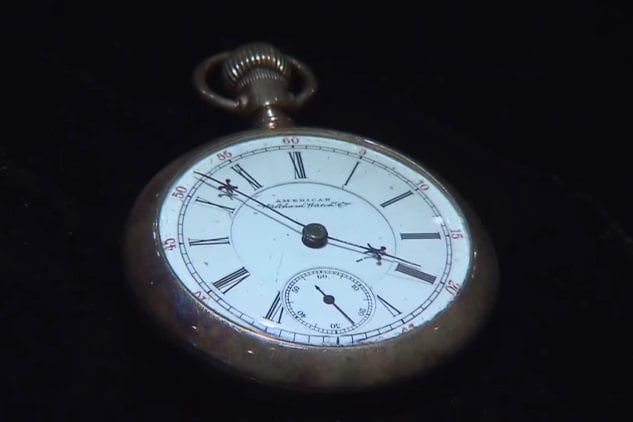
He asked for more.  He produced a watch and chain, a complex looking mechanism with several dials and minute hands that were stilled by a usually inexorable Time, something he called a Chronometer, a term I had not heard before.

"Honorable, sir," he said, "the watch does not function.  Perhaps you will see to its repair?"

I took the watch without comment and placed it in my pocket.  

The following day, the orders changed.

"Proceed as if they are ordinary prisoners."

Thus, they were processed, searched, divested of property of military meaning, and sent to appropriate compounds.  Such are the winds of conflict.  I saw no more of them, or heard, until this stained letter arrived, sent some months ago.  It began:

"Honorable Sir, I lose much face before my father.  I do not preserve the one thing he gave me that he had to give, the watch which I trust with you for repair."

I put the letter down and searched my various pockets.  There it was, the little hands as still as they were when he gave it to me.  My intention then was not to attempt a repair as he asked. I am sure I gave it little thought.  Now, it occurred to me I would not give it back, even if I could.

I remembered another watch, not as elaborate as this one, suspended with an ordinary chain, that the Chaplain removed from the body of a boy on a lonely Italian hill. There were some cigarettes also, for which the departed had no further use.  The Chaplain offered the crumpled package to some of us.

"Boys, there's nothing wrong with the cigarettes, take them."

We did not.  There was the initial fear of ultimate contagion.  It was our first encounter with death.

The letter spoke also of Death.

"My father was dying when he gave me the watch. He said, 'this is all I have to give, as I have failed in life.  It is all I leave you to bestow, in turn, on your son.'"

There is no place, I thought, for sentiments of this kind.  There are human impulses in a world only half human.  I was not moved to pity.  If I had any tears, they would go to the dead boy on the  hill whose father and mother would receive, among other effects, the watch with the ordinary chain.

There was no more I wanted to read.  I took the watch and held it by the ornate chain.  The motionless hands were fixed on the Roman numeral twelve.  It could not have been noon when they ceased their journey.  It was the season of midnight and darkness in the world.  I swung the watch in an arc and dashed it on the ground.  I felt a tear descending on my cheek.  I allowed it to make its way where such errant drops are wont to go.

Friday, September 21, 2018

Thad Mumford: A Personal Reflection


Image result for Photos of Thad Mumford

Reaching for long ago and probably not always accurately chronological memories in my mind, it was in the 8th or 9th year of M*A*S*H, the wildly successful comedy/dramedy about a medical unit during the Korean War, that I first met Thad. It was, for sure, the late 1970s. I was in law school, in New York, but made my second trip in 1978 to Los Angeles, having fallen in love with it the year before during the first visit. I had formed the idea of being an attorney very early, when I was about 14, for reasons that, frankly, still elude me now that I am retired from practice. But a sojourn at my college radio station, WFUV, Fordham University, had me hankering for one of two different roads.  Either I wanted to be an on air talent, or courtesy of a half-hour radio sitcom a fellow student, Len Klatt, produced, wrote and directed, (surprise of surprises as I had never harbored the desire before junior year of college) a television writer. So, before law school I worked at a local New York radio station behind the scenes, and almost got a job as a rip and read newscaster at another local station in Lakewood, New Jersey, until my father's impassioned logic (yes, there is such a thing!) convinced me that I ought to seek a more linear career. That didn't mean I couldn't pursue the writing thing, and by the end of my college experience in 1976, Len and I had become writing partners.

The enterprising Len had discovered that Thad was a former student at Fordham University, our Alma Mater, and also the Alma Mater of Alan Alda, the star of  M*A*S*H. The former was only three years or so ahead of us.  At some point, Thad actually read one of our speculation scripts and sent an enormously encouraging letter. And I suppose it is at that moment, I mark the beginning of a 40 year friendship.

Len had already met Thad in 1977 during a trip to Los Angeles. During a joint vacation trip with Len to Los Angeles in 1978, I had my chance. My memory is vague where I was introduced exactly--I think it was before or during my first visit to a television studio, Twentieth Century Fox to let Len and I see the set, and introduce us to a few of the cast members. I have three impressions of the introduction, rather than memory.

The first was that Thad had an amazing handshake. It was strong, and sustained. I always liked good handshakes. There's nothing like someone seeming glad to meet you that inspires confidence, someone who has an energy. The second was his casual/not casual dress, a polo shirt under a well tailored hounds tooth jacket. Like many of his friends, I would later learn that Brooks Brothers was his primary, if not sole, haberdasher. I am certain that a few years ago, when we had dinner, he was wearing the very same jacket, or one of its later iterations. The third was that I found him incredibly attractive. It was many years later that I admitted that to very few friends. And it always remained the case though I never revealed it to Thad. There was something dangerous about Thad. And the one thing I never have done in my life, particularly as to relationships, is dangerous. But that didn't mean I wasn't attracted to it. And couldn't be a friend.

Oh, I suppose there was a fourth thing as I recall riding in the back seat of Thad's BMW on the way, perhaps, to the studio where we got that great tour, met Loretta Swit, and Harry Morgan, and Alan Alda, and watched a scene being filmed.  I was feeling a little embarrassed. I was still in law school and living at home, driving my Dad's Pontiac Volare, on rare occasion when I drove at all. Here was this guy just a few years older than me and he had already been a writer for more than a few television shows. I mean he had done an episode of ROOTS, an historic mini-series. And there had been the Electric Company. And then, pun intended, there was Maude. I had maybe 4,000 dollars in the bank, and I was still in school, and a neophyte writer, if the fates allowed.  This guy took risks. I didn't know if ever I would take such a risk to forego a regular job for a creative life. No, I knew. Unless the winds of chance blew a major, and blatant, opportunity, my way, I was going to take the safer route.

Well, I shouldn't have been so hard on myself I suppose, for I did take a risk of sorts, in 1981, and moved to Los Angeles hoping to get a job in the law (once I got my law license there as well as in New York) while continuing to write with Len, who still lived in New York. Both of us had remained in touch with Thad, but in different ways, and in different intensities. To say that Thad was a sports fan would be to understate his passion. He had not only been a bat boy for the Yankees, the genesis of which I used to, and I am sure many others who cared for him felt was a key part of an autobiography he should have written (an a biography someone I hope will consider), but hockey was life's blood to him as well, the Kings his team. That wasn't an area in which I excelled in conversation, but Len did. Hockey was a sport that he not only liked, but himself played, well into this decade. When he stayed with me, for about a week, during a transition in his living quarters, his hockey bag and skates and sticks dominated my small apartment. His knees were in pain, but his soul soared when he played, even if he spent the evening with an ice pack to reduce swelling.

In 1982, when Len was visiting Los Angeles, and MASH was wrapping up its run, Thad invited us to his gorgeous little house in Burbank to watch "Goodbye, Farewell and Amen". That is at least what I remember.  His girlfriend at the time, and for my money, the love of his life, Roz Doyle, who would be a producer for WINGS (and the inspiration for the character name on Frasier) until her too early death in 1991, padded around while Thad offered his thoughts on the last episode.

Swatches of time passed. Months. Years. He moved around. Martha's Vineyard. Washington, where he grew up. Places of which I have no idea. Back to Los Angeles as he did other series. The man was a prolific creative force. Len would hear from him; they'd see each other when Thad was in New York.

In the meantime, writing as a focus became impossible with my various jobs, first as a secretary while I passed the California Bar, then as an attorney with a single practitioner, then as a prosecutor for the State Bar. Safe had beckoned and I had gone to her. And something about having become friends with Thad meant never asking him to pull any strings for us.

Over the years, I learned a lot about his life, and despite his persistence in getting into the business  how unsure he was of his palpable, manifest talent, and seemingly unaware of just how BIG his successes had been. I think he would be surprised just how significant he is considered to have been in the entertainment industry, now that he is gone. The obituaries correctly view him as a pioneer. My critique of the industry that gives him homage after his passing is that they weren't quite as solicitous about jobs for a more mature member of the writing community, which he had become. Though I am an outsider to the industry, I have observed that the "old time" writers have difficulty competing with the young firebrands who know very little but think they know everything.

He seemed not to have faith in his own intelligence though the proof of it was in print and on the networks and beyond. But he persisted. He had many stories left to write. Lots of them were about baseball and some of the old timers he had known. I remember meeting him for some lunch or dinner in one of his apartments while he regaled me with an escalating enthusiasm punctuated by his explosive laughter with another tale I had not heard. I would glance at his writing desk, perfectly organized, with equally sharpened pencils (Thad was not a fan of on screen writing--he was contemptuous of anything technological-- though ultimately he had to make some concessions), and index cards with incredibly neatly printed short ideas. I kept telling him to write his autobiography, this son of a teacher and a dentist, who had become a Yankee Bat Boy, written jokes for Johnny Carson and Joan Rivers, was on staff with the Electric Company, a PBS fun but educational children's show, all while he was in his 20s, who fell in love with the famous and not so famous, who was on staff or producing a bevy of the golden shows of the 70s, 80s and 90s.

He was complex, mercurial--the kind of person to whom I am often drawn-but that didn't always make it easy to be his friend.  He could push you away. Then he'd draw you back. When he was on his game, he could be charming, and conversation with him could lead to an engaging several hours. He charmed even my curmudgeonly father, with whom he shared a Thanksgiving dinner one year. Among his favorite haunts for those type of evenings was Peppone's in Brentwood. He liked the old style restaurants, the ones with the enveloping circular booths and candles and waiters a century old.

Our last conversation as of old was not at Peppone's but at the Smoke House in Burbank in March or April. Was it possible that I had known him so long? It seemed like yesterday. Everything seems like yesterday at this stage.  In the last few years, so many who have been threads in the tapestry of my life have died.

The last brief call was just before he went home to see his sick, elderly father in Washington. I think that was early August.  He was just letting me know he was going. We'd talk when he got back. His father died on August 16.

I got a text from Len on September 15. He happened to see on the net that Thad had died, apparently on September 6, only a few weeks after his father.

Thad would not be coming back.

Things sort of just suspended. Another thread, a big one, from the tapestry. I thought, "He didn't get to write his autobiography."  And then I cried for a while.


Thursday, September 13, 2018

Oh, the Pain!

Image result for Dr. zachary smith

I suspect I looked a great deal like Dr. Zachary Smith over this last weekend. A long since crowned tooth that purportedly had a root canal some 15, 20, or 30 years ago--I don't know when--suddenly sprang into full throb torture. It started on Friday or Saturday last, but with it being the weekend, and my having a yard sale long planned with a friend that could not be put off, the best I could do to address its early and not completely unbearable stage was to chew aspirin. I'd get a couple of hours before I needed more. And I knew I had to be careful on that score not to kill my stomach in the process of addressing the pain in my tooth.

By Monday morning, I realized that though I am a follower of a faith for which a Theology of  Suffering is a major tenet, I was failing the course. I had wended my way into "big wimp" territory. There were beginning to be tears. I held off on the gnashing of teeth as that would only cause more pain!

I called my newest dentist who is in the locale of my two former dentists and begged for an appointment which could not be managed till 3 p.m. I knew it was unlikely any actual work could be done on the tooth, but I was counting on something to address the pain and what I was sure was a whopper of an infection. You see, I am ashamed to say, that I have had a lot of dental work in my life.  I have had several implants after one or two of the roots on crowned teeth broke irreparably. Though I regularly brush, I have not been a perfect flosser. In fact, truth be told, I probably haven't been an imperfect one. But anyway, I have had enough work to know when there is an infection.

X ray. Yep. Infection. Antibiotic. And a painkiller, something a little dicey, Hydrocodone with acetaminophen. And an appointment on Wednesday. I had high hopes for the Hydrocodone as I began the antibiotic. It is supposedly the strongest type of painkiller. And alas, it only took the edge off for about a half hour in any given dose. Smart enough I that I didn't double down. And so Tuesday was a marathon to getting to Wednesday.

And so it began at 9 a.m. Wednesday. The sawing off (that's what it sounded like; not sure I'll get that one back if the re-treatment works; that's what they call it when they try to do a second root canal on one that was not sufficient) of the crown. This was after, of course, an abundance of pricks by a very sharp needle to deliver pain killing salvation to me aching mouth. And then the digging into the old cavern of my previously rooted canals. I had the thought that the inside of my tooth was not unlike the tombs of the ancient Egyptians--never meant to have anyone clawing about once they had been sealed.  But then, there they were, the instruments of excavation. At first, there was no pain, just the sounds and vibrations of the equipment motors.

And then I was feeling something. It wasn't the throbbing per se. It was a building ache. From somewhere. It was hard to intercept the drilling dentist with the rubber damn on my face. But I mumbled, "I'm feeling something." It was some of the infection. And as she digged deeper, there was an exquisite sharp pain. "There shouldn't be any pain!" I thought. I was numbed to the nth degree.
But there it was. And I sang a scream. And then there was relief as something building up had been released. It happened several times. "Are you in a choir?" asked one of the assistants. I was. I had forced my scream into a sing song to avoid any expletives. Interesting that I even thought to do that.

"Everything's ok back here!" shouted the various folks attending me to the patients in other rooms. I laughed loudly. Now, I hoped, they would believe it, my fellow sufferers in chairs outside of my sight.

But there would be no re-treatment this day said my dentist. Too much infection. We have to have the rest of it drain, and I was prescribed a second antibiotic to be taken with the first, as they apparently have different targets. And another painkiller, hopefully more effective than the first, which I have already retired. Because of the digging about in my tooth, some of the infection had kind of bunched up into a swelling on my cheek/jaw. The pain was not gone, but it was greatly abated. That was enough for me given the intensity of the prior several days.  An appointment again, next week.

Tonight. The swelling is less, though not gone. I have been assured that by the end of 72 hours it will be more or less gone. There is something exhilarating about the absence of pain. I look forward to it.

Oh, the pain. I am glad it is nearly gone!


Monday, September 3, 2018

Be Not Afraid, Stand Firm

"From some fissure the smoke of Satan has entered the Temple of God. . ."  Paul VI, 1972

It's not the first time, of course. That as Paul VI pointed out in his prophetic words, was in the Garden of Eden. God spoke His terms of love. Adam and Eve had all they needed, but they would not obey one directive and sought divinity on their terms, rejecting the Divinity which created them. God makes covenant with His Creatures. He has made made covenants over and over since that fateful and willful choice of mankind to take the knowledge of good and evil and attempt to usurp and deceive the Creator. And then, finally, He sent Salvation itself. He gave us the Church and told us what we needed to do. He laid Hands on the Apostles and they, given authority under God, laid hands on men for two thousand years to be our teachers, our preachers, and those consecrated to be the instrument for the Presence of the Eucharist, which Catholics believe IS God Himself giving us Grace to do His Will.
s
Pope Paul VI called it "the smoke of Satan".  In his disguise as a snake, Satan merely talks to Eve. He tells her that something is good--pleasurable, a special knowledge--which is not good for her, or for her husband. His message is kind of the original "Why not?". No need for limitation, though of course, humans are limited. No need for obedience. Who is this God anyway, telling you what to do? And He probably doesn't mean it anyway. Satan insinuates. He cajoles. And Eve begins to see no obligation to obey, in love. And then Eve insinuates, quietly, her husband. And then, well, "All hell breaks loose!"

Somehow, in a disguise of unimpeded modernity, convincing man of a unilateral power he can never have, Satan directed his smoke not only at the laity of the Church--half of whom routinely dismiss the precepts of the Church which have never changed--but at those who were consecrated as representatives of Christ, those who were given the authority to bind and loose. I can only imagine what it was like when he did his dirty work from and after the beginning of time, but I will tell you, it must have felt like the smoke after a fire thrower was unleashed. Because that's what it feels like now.

Some of them didn't just sin--which all of us do even though today we don't acknowledge that such a quaint idea--they did so in some cases while committing soul murder on innocents or on those who were otherwise vulnerable. I know they are a small portion of those who are otherwise selfless and like you and me trying to live by God's laws. But they have given Satan quite a lot to insinuate now.
"Well, look at your priests and bishops. While you were struggling with the what they told you were God's sayings, they knew that none of it was true. They were having parties and unbridled pleasure and nothing happened to them. Nothing is going to happen to them. You might as well just give up this Church thing. It has no meaning. There is only now. There is no eternity."

What these men did makes us so angry. It should. Leaving makes sense, no?

It makes sense if I don't believe in the heart of the teachings. If I believe that God is in the Transubstantiated Host and if I believe that God offers us, with the help of the Church's teachings, an individual choice to accept the Salvation offered by the Cross and Resurrection, then to leave is spiritual suicide.

The history of mankind and his relationship with God, inside and outside the Catholic Church, has been a see saw of faith and faithlessness. To say that I am leaving the Church because of the sins of men and women is to pretend that somewhere there are men and women that don't sin. In fact, I go to the Church because I believe what some think is a cliche, that it is a hospital for sinners. Some of us get better. Some of us do not. But if not there, where shall I go?

Either I believe the Truth is in the heart of Catholicism, or I don't. It looked pretty dark when Christ was crucified. Many people, who had followed Him, walked away from His teachings. Some did not.

It has always been hard not to be afraid and to stand firm. It's no different now than it was 2000 years ago. I don't want to be one who walks. I pray not to be afraid. And to stand firm.


Image result for Be not afraid, Bible