I get involved. I forget to add Dad's stories to this blog, and then I find one and I think, "Let's get back to that!" So, here is a short one.
I don't really have a story to tell, today. In fact, I have a kind of reluctance about the whole project. Anyway, it is the day before writing class, and I feel somewhat obligated. So forget literary considerations and let's get on with it.
In the third year of my marriage, I began graduate courses at NYU, in Washington Square, NY. Actually I enrolled in the program since if I stopped my GI Bill Entitlement, the monthly checks would stop, and I still needed the bread.
She came into the class in the middle of the semester. She was tall, slim and long haired and spoke a fluent French. I soon noticed that despite random possibility, it seemed she was always sitting on one side of me or the other. I looked, peripherally at first, then appraisingly. We spoke, and soon lunch was a daily affair.
She made it plain that she was attracted to me. I avoided any commerce outside the university area. She began asking probing questions. The theme was obvious. She was asking if I were gay.
Ok, you may rightfully say, "Why didn't you tell her you were married?"
That's a woman's question. How often does a man encounter a sucubus, a rare charmer?
The fever reached its height when she did several scenes as Roxanne, in a reading of Cyrano de Bergerac. I was entranced.
I scribbled several lines of poetry on the inside cover of a text book. I insist this was simply a scholarly exercise, inspired by the beauty of Rostand, the author of the work.
To make a long story short, my wife stumbled on the opus. She said she had been dusting the book shelves.
"Are you seeing another woman?" she said.
No man can deliver an articulate answer to this question.
"Of course not," is a standard answer.
Moreover, no man has the intuitive perception of the female. About the charmer:
We were walking down the stairs on our way to lunch when she stopped suddenly.
"Ah, oui," she said in revelation, "vous etes marie, you are married."
Friday, April 20, 2018

Life, and Death, and Life
I know. Some of my friends among you worry when I write what you feel are "gloomy" posts on these pages. So that you don't generally worry too much, I was the 16 year old reading "Thanatopsis". I have always tended toward what I suppose is existential angst. If my Catholic faith were not a key aspect of my life, I suspect I could easily have fallen into a dark hole. I may have circled the hole from time to time, but Thank the Lord, never fell in.
So, let's be clear, this entry need not evoke a "What's with DjinnfromtheBronx?" It just happens in my travels I see certain things perhaps more than others. So, because I visit someone regularly in a nursing home, and informally volunteer with an art class at the site, I am around people at the end or near end of their lives. And sometimes the end of a life, to the observer, sort of has a way of integrating itself subtly into our living world in one moment so to be a rather amazing experience for its passing appearance. This happened the other day.
I had been helping my elderly friend create what turned out to be quite beautiful painted coasters. She is at that stage of her dementia where it is hard for her even to follow directions, but I think I can safely say that she participated more than usual in the work we did as a team. Two lovely coasters were produced, but I could see she had had enough so I took her out to the wing's lobby area. There was a comfortable leather like deep chair for me and for both of us a view to the outdoors in this lovely setting. It was a little too breezy to take her outside.
She pointed to the trees and the perfect plein air expanse and said, "This is a famous place." I don't know about famous, but it sure is bucolic. She asked me questions about my two cats, which somehow she remembers though she saw them only once, while she can not remember a moment before, nor people she knew for years. What she remembers also well is that Catholic Faith that has sustained her and her delight that I help at the parish, lectoring and serving as needed. She asks me with rhetoric repetition, "You are still on the altar?" Whenever a nurse or visitor she has many times met comes in, as happened once or twice that day, she will say, "You look so pretty!" It never fails that they take her hand, cheered by her kind words which substitute for a hello and hide her failing memory.
And so, there we were. I noticed some errant paint on her fingers and was thinking that before I left that day I would bring her back to the activity room and clean them off. She was in a good frame of mind. Smiling. I was in a good frame of mind. Smiling.
Then a series of people, clearly family members of someone, passed us by toward the exit. Each was sniffling, or dabbing an eye. Someone had died. I don't know who, because they are very strict about adhering to the HYPPA laws, which is a good thing (except when someone you have known there for a long time, disappears, and you realize that it probably was death that caused it). I suspect it was one of the folks I don't often see in the activity room. They seemed to be all accounted for, in my head. Several of the nuns who run the home went outside and hugged the family, a confirmation that thre had been a passing.
My elderly friend saw them all, and asked me if I knew who they were. I said they probably were visiting someone. And that Sister so and so was just chatting with them. I did not tell her that anyone had died. It would not have impacted her because she is unaware of where she is, and seems not to remember the other residents when she is not with them, but it was unnecessary, perhaps a little inappropriate, somehow, to note something that pointed out the elephant in the room--this scene of loss has been and will be repeated for years.
And yet, in the activity room the gleeful noise of the seniors still finishing their art work--one man must at one time have been an artist, as he drew little cartoons on the coaster. And my friend did not notice the tears. And the sun still shone. And the trees still swished in the heavy breeze. And the birds were flying by with pieces of weed and fuzz constructing their nests for the new life that they would incubate.
How to phrase this? I saw the whole circle in that few moments. I wanted to say something to the family, but I didn't want to intrude.
I took my friend back to the activity room and got the paint off her fingers. She was content.
So, let's be clear, this entry need not evoke a "What's with DjinnfromtheBronx?" It just happens in my travels I see certain things perhaps more than others. So, because I visit someone regularly in a nursing home, and informally volunteer with an art class at the site, I am around people at the end or near end of their lives. And sometimes the end of a life, to the observer, sort of has a way of integrating itself subtly into our living world in one moment so to be a rather amazing experience for its passing appearance. This happened the other day.
I had been helping my elderly friend create what turned out to be quite beautiful painted coasters. She is at that stage of her dementia where it is hard for her even to follow directions, but I think I can safely say that she participated more than usual in the work we did as a team. Two lovely coasters were produced, but I could see she had had enough so I took her out to the wing's lobby area. There was a comfortable leather like deep chair for me and for both of us a view to the outdoors in this lovely setting. It was a little too breezy to take her outside.
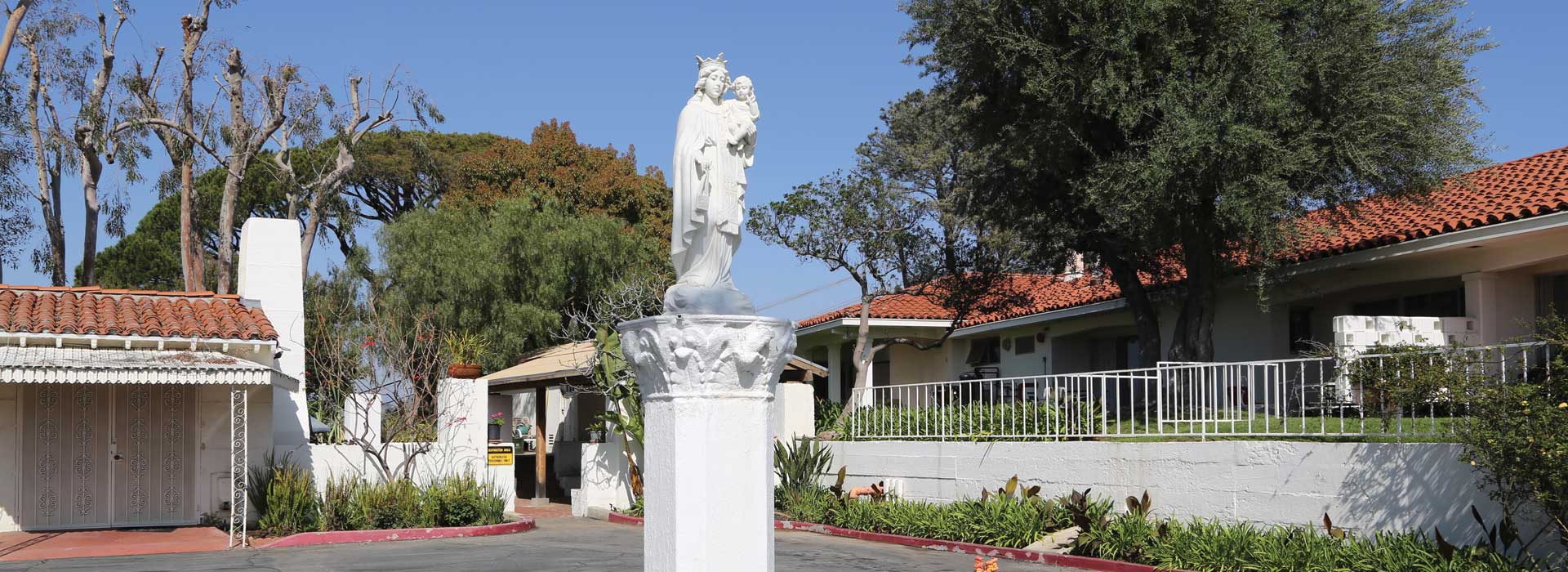 |
| The other side of where we were sitting, but lovely. |
She pointed to the trees and the perfect plein air expanse and said, "This is a famous place." I don't know about famous, but it sure is bucolic. She asked me questions about my two cats, which somehow she remembers though she saw them only once, while she can not remember a moment before, nor people she knew for years. What she remembers also well is that Catholic Faith that has sustained her and her delight that I help at the parish, lectoring and serving as needed. She asks me with rhetoric repetition, "You are still on the altar?" Whenever a nurse or visitor she has many times met comes in, as happened once or twice that day, she will say, "You look so pretty!" It never fails that they take her hand, cheered by her kind words which substitute for a hello and hide her failing memory.
And so, there we were. I noticed some errant paint on her fingers and was thinking that before I left that day I would bring her back to the activity room and clean them off. She was in a good frame of mind. Smiling. I was in a good frame of mind. Smiling.
Then a series of people, clearly family members of someone, passed us by toward the exit. Each was sniffling, or dabbing an eye. Someone had died. I don't know who, because they are very strict about adhering to the HYPPA laws, which is a good thing (except when someone you have known there for a long time, disappears, and you realize that it probably was death that caused it). I suspect it was one of the folks I don't often see in the activity room. They seemed to be all accounted for, in my head. Several of the nuns who run the home went outside and hugged the family, a confirmation that thre had been a passing.
My elderly friend saw them all, and asked me if I knew who they were. I said they probably were visiting someone. And that Sister so and so was just chatting with them. I did not tell her that anyone had died. It would not have impacted her because she is unaware of where she is, and seems not to remember the other residents when she is not with them, but it was unnecessary, perhaps a little inappropriate, somehow, to note something that pointed out the elephant in the room--this scene of loss has been and will be repeated for years.
And yet, in the activity room the gleeful noise of the seniors still finishing their art work--one man must at one time have been an artist, as he drew little cartoons on the coaster. And my friend did not notice the tears. And the sun still shone. And the trees still swished in the heavy breeze. And the birds were flying by with pieces of weed and fuzz constructing their nests for the new life that they would incubate.
How to phrase this? I saw the whole circle in that few moments. I wanted to say something to the family, but I didn't want to intrude.
I took my friend back to the activity room and got the paint off her fingers. She was content.
Saturday, April 14, 2018
A New Attitude in Long Beach and Beyond--That's the Plan
Back in the summer of '78, I made my second trip to Los Angeles. I was still in law school in New York, had another year before I'd graduate and probably another year, after that, before I'd be able to take the New York Bar. But I had plans by then to find a way to move to land of palm trees and sunshine. Well, not exactly plans, but I was intensely thinking of how I could wend my way out here.
I had, with regard to making the move, getting out the too much cold in winter and too much humidity in summer, a rare thing, for me, a positive attitude. It wasn't just about the weather, though. It was Los Angeles where I thought, as many have before me, that I could make my mark, as a television writer, with my then partner, Len Speaks. As I was driven around back then--I didn't have a license of my own yet--the scented streets (orange blossoms, jasmine, all of it), the palm trees swishing in the breeze, the cloudless cobalt blue sky, and the sunshine somehow different from that of New York, yes, all that cliche stuff, and the radio playing some favorite tunes that gave me optimism. In 1978, the tune of good omen, because of its spectacular sax and the only lines I could actually hear, "When you wake up, it's a new morning, the sun is shining, it's a new morning, you're going home," was "Baker Street" because it would pop up at what seemed to me strategic times during the visit. Actually the song is about depression and alcoholism, but well, the song was hot, the music was cool and I felt energized by it. By 1980 it was Steve Winwood, "When You See a Chance".
"When some cold tomorrow finds you.
When some sad old dream reminds you
How the endless road unwinds you
While you see a chance take it
Find romance
Fake it
Because it's all on you."
I finally saw a chance in 1981, after I passed the New York Bar, to make the move to Los Angeles, and I took it. By then the song that gave me a sense of optimism was from a television show, "The Greatest American Hero"--"Believe it or not, I'm walking on air; I never thought I could feel so free; flying away on a wing and a prayer; Who could it be? It's just me."
My partner didn't make the move then, and I hoped I could till the television writing ground while I studied for the Bar and got a job. I wrote a bit, beginning a spec script for Remington Steele, just as it was cancelled, and one for a favorite of mine, Cagney and Lacey, to keep my creative juices flowing. But I couldn't devote time to both writing and making a living. And life went in a different direction.
Where does Long Beach come into all this? Well, in the 1990s, I decided I needed to work out some of the neurotic quirks of my nature. I had taken a chance and though I wasn't a staff comedy writer at Twentieth Century Fox or Warner Brothers, I was reasonably successful in the career that I had, wisely, prepared for while I pined to be a Hollywood writer. I had a circle of West Coast friends and still had contact with a number of my East Coast ones. But, I had done less well in either finding romance, or faking it and my usually hidden version of Obsessive Compulsive Disorder, full of catastrophic "What ifs" (which had manifested itself in various versions over my life but which I had managed with a combination of dismissal, denial and changing certain aspects of my daily life), was interfering with my ability to make decisions about pretty much anything. Not good for anyone, but particularly problematic if your job was being an ethics attorney. And when you do that sort of thing all the time, you get a little anxious and a lot depressed.
I began therapy at a location near LAX but when my therapist moved to Long Beach, I decided that the drive to a beach community was a nice complement to my appointments. After one of my last appointments, I had taken myself for lunch on Second Street, and as I walked on the street window shopping, I noticed that my hair looked particularly awful. I had parted ways with my prior hair stylist, not because she was in any way wanting, but because I had had a particularly bad experience with the salon at which she was then working. I walked into Effie and Company, begged for hair help, and was matched with Rosendo, who remains my hairdresser to this day.
It has always been like a day vacation when I go down there. Get my hair done. If the weather is invariably good, make a stop at an on beach or near to the beach locale for lunch. Often someone comes with me, my cousin, my aunt, a friend.
I had to cancel several appointments in the last few weeks due to other intervening activities. But today, I was able to go. Today, I needed to do it alone. No particular reason. It is a breezy, beautiful day, just like those days I was so aware of when I first came to California. I wanted to be able to blare the radio, and sing along. I even "forgot" my cell phone.
I found a new restaurant along Second Street, open only since August, Pietri's Bakery, Greek run, full of breakfasts, and pastry made on the premises, and a cheery shiny atmosphere. I saw on a side street this incense, crystal, chimes store on the side street and bought a few tchochkes I didn't need and then some cosmetics I also didn't need. Driving back along Ocean, amid the revving of the Grand Prix held once a year, I was alternating between the 60s on 6 or the 80's on 8 on Sirius Radio.

That feeling, the one I had when I was a 20 something first in Los Angeles began to overtake me, out of nowhere. Here I am free of the need to work, and I am not fully taking advantage of the opportunity to spend the time doing the type of writing I intended to do when I first moved to Los Angeles, but couldn't because I had a fully occupying my time job. That isn't an issue now. It hasn't been for quite a while.
I do not need to make a living at writing. I have to get over the idea that I need to succeed in any traditional way. That period of my life, happily, is over. I somehow lost track of that wonderful fact. I have always seen my life in terms of responsibilities. I have a few now, but they ought not, they need not be allowed to generate old anxieties. That's what Long Beach did for me today. Reminded me.
Yep, as I drove home first along Ocean, then to the 405, the wind quite truly blowing through my now messed up coif, I thought, maybe for the first time, truly, that today is a beginning, not a prelude to any end--which is my tendency to think as my glass half empty nature can be tamed, but apparently not eradicated.
So lots of songs popped up as I was rolling along, and the lyrics of another 80s classic caught my ear, Patti Labelle's "New Attitude".
"I'm feeling good from my head to my shoes
Know where I'm going
And I know what to do.
I tidied it up
My point of view
I got a new attitude."
I really was feeling good from my head to my shoes. That's a great thing.
I had, with regard to making the move, getting out the too much cold in winter and too much humidity in summer, a rare thing, for me, a positive attitude. It wasn't just about the weather, though. It was Los Angeles where I thought, as many have before me, that I could make my mark, as a television writer, with my then partner, Len Speaks. As I was driven around back then--I didn't have a license of my own yet--the scented streets (orange blossoms, jasmine, all of it), the palm trees swishing in the breeze, the cloudless cobalt blue sky, and the sunshine somehow different from that of New York, yes, all that cliche stuff, and the radio playing some favorite tunes that gave me optimism. In 1978, the tune of good omen, because of its spectacular sax and the only lines I could actually hear, "When you wake up, it's a new morning, the sun is shining, it's a new morning, you're going home," was "Baker Street" because it would pop up at what seemed to me strategic times during the visit. Actually the song is about depression and alcoholism, but well, the song was hot, the music was cool and I felt energized by it. By 1980 it was Steve Winwood, "When You See a Chance".
"When some cold tomorrow finds you.
When some sad old dream reminds you
How the endless road unwinds you
While you see a chance take it
Find romance
Fake it
Because it's all on you."
I finally saw a chance in 1981, after I passed the New York Bar, to make the move to Los Angeles, and I took it. By then the song that gave me a sense of optimism was from a television show, "The Greatest American Hero"--"Believe it or not, I'm walking on air; I never thought I could feel so free; flying away on a wing and a prayer; Who could it be? It's just me."
My partner didn't make the move then, and I hoped I could till the television writing ground while I studied for the Bar and got a job. I wrote a bit, beginning a spec script for Remington Steele, just as it was cancelled, and one for a favorite of mine, Cagney and Lacey, to keep my creative juices flowing. But I couldn't devote time to both writing and making a living. And life went in a different direction.
Where does Long Beach come into all this? Well, in the 1990s, I decided I needed to work out some of the neurotic quirks of my nature. I had taken a chance and though I wasn't a staff comedy writer at Twentieth Century Fox or Warner Brothers, I was reasonably successful in the career that I had, wisely, prepared for while I pined to be a Hollywood writer. I had a circle of West Coast friends and still had contact with a number of my East Coast ones. But, I had done less well in either finding romance, or faking it and my usually hidden version of Obsessive Compulsive Disorder, full of catastrophic "What ifs" (which had manifested itself in various versions over my life but which I had managed with a combination of dismissal, denial and changing certain aspects of my daily life), was interfering with my ability to make decisions about pretty much anything. Not good for anyone, but particularly problematic if your job was being an ethics attorney. And when you do that sort of thing all the time, you get a little anxious and a lot depressed.
I began therapy at a location near LAX but when my therapist moved to Long Beach, I decided that the drive to a beach community was a nice complement to my appointments. After one of my last appointments, I had taken myself for lunch on Second Street, and as I walked on the street window shopping, I noticed that my hair looked particularly awful. I had parted ways with my prior hair stylist, not because she was in any way wanting, but because I had had a particularly bad experience with the salon at which she was then working. I walked into Effie and Company, begged for hair help, and was matched with Rosendo, who remains my hairdresser to this day.
It has always been like a day vacation when I go down there. Get my hair done. If the weather is invariably good, make a stop at an on beach or near to the beach locale for lunch. Often someone comes with me, my cousin, my aunt, a friend.
I had to cancel several appointments in the last few weeks due to other intervening activities. But today, I was able to go. Today, I needed to do it alone. No particular reason. It is a breezy, beautiful day, just like those days I was so aware of when I first came to California. I wanted to be able to blare the radio, and sing along. I even "forgot" my cell phone.
I found a new restaurant along Second Street, open only since August, Pietri's Bakery, Greek run, full of breakfasts, and pastry made on the premises, and a cheery shiny atmosphere. I saw on a side street this incense, crystal, chimes store on the side street and bought a few tchochkes I didn't need and then some cosmetics I also didn't need. Driving back along Ocean, amid the revving of the Grand Prix held once a year, I was alternating between the 60s on 6 or the 80's on 8 on Sirius Radio.
That feeling, the one I had when I was a 20 something first in Los Angeles began to overtake me, out of nowhere. Here I am free of the need to work, and I am not fully taking advantage of the opportunity to spend the time doing the type of writing I intended to do when I first moved to Los Angeles, but couldn't because I had a fully occupying my time job. That isn't an issue now. It hasn't been for quite a while.
I do not need to make a living at writing. I have to get over the idea that I need to succeed in any traditional way. That period of my life, happily, is over. I somehow lost track of that wonderful fact. I have always seen my life in terms of responsibilities. I have a few now, but they ought not, they need not be allowed to generate old anxieties. That's what Long Beach did for me today. Reminded me.
Yep, as I drove home first along Ocean, then to the 405, the wind quite truly blowing through my now messed up coif, I thought, maybe for the first time, truly, that today is a beginning, not a prelude to any end--which is my tendency to think as my glass half empty nature can be tamed, but apparently not eradicated.
So lots of songs popped up as I was rolling along, and the lyrics of another 80s classic caught my ear, Patti Labelle's "New Attitude".
"I'm feeling good from my head to my shoes
Know where I'm going
And I know what to do.
I tidied it up
My point of view
I got a new attitude."
I really was feeling good from my head to my shoes. That's a great thing.
Friday, April 6, 2018
The Weaponized Car

Perhaps I am noticing things because I recently had to consume and memorize the 93 page Drivers Manual so I could take the Department of Motor Vehicles written test for the first time in what I think has been at least fifteen years. (Happy to say I passed, and happy to say I will have a new picture!) I have got to say, though, that the drivers in Los Angeles (though I suspect the same is true in New York, Boston and all those cities which probably resemble Skinner mazes more than civilized metropolises) seem to take particular delight in ignoring all regulatory, hazard and warning signs. Unfortunately, they are doing so while careening in 4,000 mass of metal and plastic.
This day, alone, I saw two people zip past a decidedly red light, and two, just in front of me, turning left at 4:45 in the usual slog of traffic, though the sign clearly said no turns left as of 4 p.m. It is much the same every day, adding in passing without signalling, ignoring any idea of a "three second behind the car in front of you" rule, and making right or left turns from middle lanes, also without benefit of signal.
I remember the quaint days of courtesy. On my very first visit to La La Land, when in New York, the idea of letting a pedestrian cross either at a light or at an intersection without traffic control, the drivers always stopped. It was positively mesmerizing, and to tell the truth, I didn't quite trust it. Once I moved to Los Angeles, and for many years thereafter, the drivers and pedestrians existed in a zen like peacefulness for which the West Coast was a model. I can't tell you when it changed, but suddenly horns were honking like I was back East, and pedestrians as well as those drivers who actually followed the law became target practice. The demyelination of psychological nerves of a society in decay has given us the "weaponized car", among its other symptomologies.
Regulation, and 93 pages tells me there is a lot of it, along with all sorts of financial and legal consequences (e.g. littering, 1000.00 fine that a cop won't bother with while he is doing the pit maneuver on some guy in a car evading him after he ran a stop sign all on TV for our viewing pleasure) makes precisely no difference.
And then, of course, in California, which is wildly concerned with drunk driving (as it should be of course) and the Blood Alcohol level of everything from a teenager to an Uber driver, has legalized recreational marijuana. Oh, of course, they remind the populace that it is illegal to use and drive still. Tell that to the guy in front of me who was blowing the smoke of his joint out of the SUV in front of me one time recently. Tell that to the guy who was smoking weed while we were all waiting to get into the DMV for our various tests. They already know is states like Colorado, which legalized marijuana before California did, that there is an uptick in DUI's, or as I will call it, "DUWI", "Driving Under Weed Influence". Seems kind of like adding to the arsenal rather than limiting it.
But to me the bigger problem is the attitude of my fellow citizens. It isn't merely that they believe the rules do not apply to them. It is that they have so little regard for other people's lives (they have a sense of invincibility borne of their narcissism). The car, not unlike the gun that is currently the subject of cyclical discussion, gives this increasing subset of an already frail humanity, a sense of unlimited power and control. They certainly have the power to kill. What they don't have is the control they imagine as they cut and weave among us.
The long-term solution seems impossible in light of the level of regression. For that some of us look to a Higher Power recognizing that man always fails as the self-designated center of all things. The short term solution though is rather the Giulani model of the "broken windows" days in New York.
Small things matter. When someone spits on the sidewalk, there should be a ticket. When someone turns left at 4:45 where the sign says you cannot beginning at 4 should get a ticket. Every time.
No discussion. And for every small thing that is ignored because there are "bigger" crimes need to have the attention of police authorities or other traffic authorities. There is, manifestly, the slippery slope. We are nearly at the end of it going into the muck.
But then, in California, at least, the authorities are trying to ban cars by their policies. Then everybody can go to the subway, where, naturally, there will be no crime as people are much nicer there. And if you believe that, I have a bridge in New York I can have imported to Los Angeles.
Thursday, April 5, 2018
Thinking on Mr. Rogers
I was too old to watch Mr. Rogers when he began his something like 30 year run on Public Television. I think he began his Mr. Roger's Neighborhood in about 1968, when I was already a teenager. I was of the Romper Room and Captain Kangaroo generation.

I was always aware of the quiet, simple presentation of his show, and when he was on the air, he was subject of satire. He was a slight man. He spoke in clear, but very soft tones. He had no interest in competition or the usual trappings of success. A society like ours has long been distrustful of anyone who seems to be well. . . .good. His show has been re-run and new little ones have had the opportunity to escape, if only for a half hour or so, the realities the adult world imposes on them. And Mr. Rogers seems to have been a very different adult from the general species.
That's why I find myself worrying about Mr. Rogers a little. Some 15 year after his death, there is renewed interest in him. There have been short documentaries, like one you can see on YouTube or the like, called "Mr. Rogers and Me". Then there is a longer theatrical documentary that is going to be released in the summer and the most recent announcement is that Tom Hanks is going to play him in a biographical release of some sort. At the moment, Mr. Rogers has been given a kind of secular sainthood.
But that's what triggers the worry. I have never known the media or human beings generally not to seek the chink in any hero or heroine's armor. There is almost a game in it--build the person up, write glowing things for a long time, and then, one day, a rumor, and then a snippet in a paper or on the net, and then an investigative story that takes the shine from any character. It isn't always true, but once the whiff of scandal is in the air, truth becomes irrelevant. Salacious sells and comforts the rest of us that no one can be THAT good.
More than anything, maybe because I have watched interviews with Mr. Rogers and seen many clips of his show since I heard about the new movie with Mr. Hanks that is pending, I have felt what I think the children and their parents have felt for years upon end, as I watch him, a sense of peace and a delight that there are people who not only have no agenda, but who might truly be models for the rest of us.
I would like Mr. Rogers to survive the scrutiny that will likely descend upon him, though he is in earthly repose, and hopefully in celestial joy, when both documentary and movie are released.
I want the shine to survive the human need to detract and reduce. Maybe this time the crown of secular sainthood will be undisturbed.
I was always aware of the quiet, simple presentation of his show, and when he was on the air, he was subject of satire. He was a slight man. He spoke in clear, but very soft tones. He had no interest in competition or the usual trappings of success. A society like ours has long been distrustful of anyone who seems to be well. . . .good. His show has been re-run and new little ones have had the opportunity to escape, if only for a half hour or so, the realities the adult world imposes on them. And Mr. Rogers seems to have been a very different adult from the general species.
That's why I find myself worrying about Mr. Rogers a little. Some 15 year after his death, there is renewed interest in him. There have been short documentaries, like one you can see on YouTube or the like, called "Mr. Rogers and Me". Then there is a longer theatrical documentary that is going to be released in the summer and the most recent announcement is that Tom Hanks is going to play him in a biographical release of some sort. At the moment, Mr. Rogers has been given a kind of secular sainthood.
But that's what triggers the worry. I have never known the media or human beings generally not to seek the chink in any hero or heroine's armor. There is almost a game in it--build the person up, write glowing things for a long time, and then, one day, a rumor, and then a snippet in a paper or on the net, and then an investigative story that takes the shine from any character. It isn't always true, but once the whiff of scandal is in the air, truth becomes irrelevant. Salacious sells and comforts the rest of us that no one can be THAT good.
More than anything, maybe because I have watched interviews with Mr. Rogers and seen many clips of his show since I heard about the new movie with Mr. Hanks that is pending, I have felt what I think the children and their parents have felt for years upon end, as I watch him, a sense of peace and a delight that there are people who not only have no agenda, but who might truly be models for the rest of us.
I would like Mr. Rogers to survive the scrutiny that will likely descend upon him, though he is in earthly repose, and hopefully in celestial joy, when both documentary and movie are released.
I want the shine to survive the human need to detract and reduce. Maybe this time the crown of secular sainthood will be undisturbed.
Sunday, March 18, 2018
Dad's Centenary Ten Years After His Death`
Madeo, a fancy little Italian eatery, whose clientele has been both celebrity and celebrity watcher since 1985, has closed within the last couple of weeks. When I read this I felt another pang of inevitable change that disturbs the pleasant memories of days gone by. This was the place I took my late father for dinner on the occasion of his 90th birthday. We were joined by a woman he had not seen in nearly 30 years. She was a love for which the timing had not been right, someone to whom he had been introduced a few years after my mother had died back in the seventies. It had not worked out, but their year or so together he ever remembered and savored. I was gratified that she was willing to fly to Los Angeles from New York to spend a weekend of memory. Dad was very sick. He would die only a few weeks later. But that evening with Sophia, Dad and Andrew and Len and me was a special one. Over the last ten years, every time I passed the restaurant, comfortably still serving food and charm, that evening and Dad's small dance step with his former love as we waited for the valet, always came to mind and brought me a comfortable nostalgic smile.

Dad had the linguine with clams, which was about twenty-five dollars at the time, and observed, "I could have made the same dish for a lot less."

There is a rumor that when whatever build out is being done in the former ICM building is completed, Madeo may return to the location. That would be nice. But it won't be the same.
Last night, I was at a dinner at my parish, of which my Dad became a parishioner at age 85, to celebrate both St. Patrick's Day and our third annual, "St. Joseph's Table". There was much Italian music, many pieces I heard routinely as a child growing up in the Bronx, which my father accompanied with his mandolin. I really wished he were with us. He would have said, "This was the best party that I have ever been to!" He said that pretty much after any party. And he would have been joining the dancing, twirling a much younger lady whom he found interesting, with debonair flair.

In a couple of weeks, had he lived, he would have turned one hundred years old. His eldest sister made that great age, but she suffered from dementia and it was a difficult last few years. I like to think that if he had survived his doctors' ministrations, he would have easily made this milestone.
He would still be telling me, and my friends, all of us now officially senior citizens, what to do. He would still be telling me, and my friends, how little we know of the world (and he might well have been right about that), and he would still be enjoying a little bit too much wine at one of those parties he loved. He would still be holding forth on the difficult past, the wild and crazy present and the apocalyptic future. If he was dissatisfied with the political direction of the country in 2008, he would be positively apoplectic today. He would not hold back his views. I would be begging him not to raise politics and he would, as always, ignore me. It is not that I necessarily disagreed with his views, then, or as I think they would be today, but I am not a provocateur. When he got to a certain age, Dad relished being a provocateur.
My relationship with Dad was complex. It was the subject of many psychotherapy sessions--as Dad suspected and about which he probed, unsuccessfully. In so many ways, we were of a kind, and so we clashed, two waves crashing on shore from different angles. But one thing was sure. Dad would throw himself on railroad tracks for me. He even attended a session with me--how many near octogenarians would do that for a daughter? I don't know that it accomplished much on his side of things--he thought therapy was an indulgence, but he was stoic in his discomfort if it would help me.

If you are lucky, when you get older, you get a bit wiser. Children expect perfection from their parents. No parent is perfect. Some are better than others though. Like many people, my father came from a difficult background. He grew up in the Depression. His parents, as he often said, with both regret and not a little resentment, "were peasants". In an of itself that 's not a bad thing, but he was speaking in short hand for how his father was trying to create a mini Greek fortress within the home, and how he held his children back with his fear and autocracy. As to his mother, it sounds as if the instinct for love was somewhat muted. As a child, I couldn't warm up to her, and she was an old lady at the time. My Dad managed to become an educated, cultured, industrious guy. His way of loving was to make a lot of food (common I think to immigrant families), and try to solve my problems, even if they weren't amenable to mere logic and persuasion. He was father, and in many ways, mother to me. As I said, it got complicated, but when I look back, I had it better than most, and with all my eccentricities, I have managed to keep my head, physically and emotionally, above water, and even, when one is really fair about it, to thrive in many ways. And he is largely the reason. He would have liked me to say that when he was alive.
The thing about Dad, which I share regrettably, is that he held himself back. That fear transmitted from his family to him was hard to overcome. He could have enjoyed more of life had he let go a little. I tried to encourage him. He counselled caution in all things. I have a sense of him sometimes, nothing really specific, having pierced the Cloud of Unknowing, telling me to let go a little now, while I still have the chance. I know he is looking after me, one of several intercessors, who I have come to trust.
"Eternal Rest grant unto him O Lord, and let perpetual light shine upon Him."
You want to hear something, Dad? I miss you.
Dad had the linguine with clams, which was about twenty-five dollars at the time, and observed, "I could have made the same dish for a lot less."
There is a rumor that when whatever build out is being done in the former ICM building is completed, Madeo may return to the location. That would be nice. But it won't be the same.
Last night, I was at a dinner at my parish, of which my Dad became a parishioner at age 85, to celebrate both St. Patrick's Day and our third annual, "St. Joseph's Table". There was much Italian music, many pieces I heard routinely as a child growing up in the Bronx, which my father accompanied with his mandolin. I really wished he were with us. He would have said, "This was the best party that I have ever been to!" He said that pretty much after any party. And he would have been joining the dancing, twirling a much younger lady whom he found interesting, with debonair flair.

In a couple of weeks, had he lived, he would have turned one hundred years old. His eldest sister made that great age, but she suffered from dementia and it was a difficult last few years. I like to think that if he had survived his doctors' ministrations, he would have easily made this milestone.
He would still be telling me, and my friends, all of us now officially senior citizens, what to do. He would still be telling me, and my friends, how little we know of the world (and he might well have been right about that), and he would still be enjoying a little bit too much wine at one of those parties he loved. He would still be holding forth on the difficult past, the wild and crazy present and the apocalyptic future. If he was dissatisfied with the political direction of the country in 2008, he would be positively apoplectic today. He would not hold back his views. I would be begging him not to raise politics and he would, as always, ignore me. It is not that I necessarily disagreed with his views, then, or as I think they would be today, but I am not a provocateur. When he got to a certain age, Dad relished being a provocateur.
My relationship with Dad was complex. It was the subject of many psychotherapy sessions--as Dad suspected and about which he probed, unsuccessfully. In so many ways, we were of a kind, and so we clashed, two waves crashing on shore from different angles. But one thing was sure. Dad would throw himself on railroad tracks for me. He even attended a session with me--how many near octogenarians would do that for a daughter? I don't know that it accomplished much on his side of things--he thought therapy was an indulgence, but he was stoic in his discomfort if it would help me.

If you are lucky, when you get older, you get a bit wiser. Children expect perfection from their parents. No parent is perfect. Some are better than others though. Like many people, my father came from a difficult background. He grew up in the Depression. His parents, as he often said, with both regret and not a little resentment, "were peasants". In an of itself that 's not a bad thing, but he was speaking in short hand for how his father was trying to create a mini Greek fortress within the home, and how he held his children back with his fear and autocracy. As to his mother, it sounds as if the instinct for love was somewhat muted. As a child, I couldn't warm up to her, and she was an old lady at the time. My Dad managed to become an educated, cultured, industrious guy. His way of loving was to make a lot of food (common I think to immigrant families), and try to solve my problems, even if they weren't amenable to mere logic and persuasion. He was father, and in many ways, mother to me. As I said, it got complicated, but when I look back, I had it better than most, and with all my eccentricities, I have managed to keep my head, physically and emotionally, above water, and even, when one is really fair about it, to thrive in many ways. And he is largely the reason. He would have liked me to say that when he was alive.
The thing about Dad, which I share regrettably, is that he held himself back. That fear transmitted from his family to him was hard to overcome. He could have enjoyed more of life had he let go a little. I tried to encourage him. He counselled caution in all things. I have a sense of him sometimes, nothing really specific, having pierced the Cloud of Unknowing, telling me to let go a little now, while I still have the chance. I know he is looking after me, one of several intercessors, who I have come to trust.
"Eternal Rest grant unto him O Lord, and let perpetual light shine upon Him."
You want to hear something, Dad? I miss you.
Thursday, March 8, 2018
Amoris Laetitia and the Ordinary Catholic like Me
Karl Marx mused that religion was an opiate for people, a way of escaping hard reality. Well, if so, then somewhere along the line I missed the hand out of numbing solace religious faith supposedly provides. Putting aside for a moment whether faith is worth it from an eschatological point of view, one thing I can say about it is that it is very hard to be a Christian. For my money it is harder indeed to be a member of the progenitor Christianity, Catholicism. When I was growing up, the dogmatic schema and its application were one and the same. There were the "rules" laid down and if violated, led to various consequences up to and including Hell itself. Confession was the safety zone, if true contrition were manifest. It was unambiguous stuff. It was difficult, nearly impossible, but at least those who were part of the faith, knew for what they were striving. At least you knew there were rules, that somebody, and/or Somebody knew better than you, that you could look into the theology maybe when you grew up, had moved to a more sophisticated locale and had the capacity to scratch the surface of Thomas Aquinas and find it sound. One problem, of course, is that the teaching of the faith back in those days did not much mention Aquinas or the Church Fathers. I mean, how do you explain all that stuff to five year olds? Or 20 year olds for that matter?
I am troubled by the various groups that, in their way, take the road of private revelation which they decry in the modern Church. Their private revelation is that if the Church restores the 1950s version of the faith, all will be well. A lot of them look at Francis and nod to themselves that we are in a time of sedes vacante (that there is no Pope on the Chair of Peter). Not so. Francis is the Pope. Where he will sit in terms of the judgment of history, I do not know. The Church has survived venal and violent Pope and Francis could never be said to be one of them. To me there is as much danger from the so-called Conservative Catholic who demands the return to ad orientum, Communion only on the tongue, and the chapel veil, as if nothing happened before the mid-20th century, as there is from the Progressive who would personally dictate the direction of the Novus Ordo into a dance free form.
This has been a long preamble. I hope you are still with me.

Those who have critiqued Amoris Laetitia and issued the "filial correction" that has been, shall we say, ignored by Pope Francis, believe, according to the December 2017 New Oxford Review, that the Pope is supporting positions on the Sacrament of Marriage, and the reception of Holy Communion, and on the moral life which are in error, if not heresy. (p. 19). The NOR posits seven problematic propositions presented by the Pope.
As quoted by NOR, I note five of them:
"1. that God's Grace is insufficient to allow a justified person to carry out the demands of the divine law, as if the commandments were impossible for the justified to fulfill.
. . .
3. that a Christian can have full knowledge of a divine law and voluntarily choose to break it but not be in a state of mortal sin as a result.
. . .
5. that sexual acts between persons who have contracted a civil marriage, although one or both of them is sacramentally married to another, can be morally right or requested or even commanded by God.
6. that moral principles and moral truths contained in divine revelation and the natural law do not include negative prohibitions that absolutely forbid particular kinds of actions;
7. and that Christ wills that the Church abandon her perennial discipline of withholding the Eucharist from the divorced and 'remarried' who do not express contrition and a firm purpose of amendment."
In the years since the various self-serving misinterpretations of Vatican II-which as it happens did not sanction the cowboy hijinks that gutted the liturgy, provide permission for the demolition of altar rails, or give apparent, but not de jure permission to "Sister Felicity" and "Fr. Kant" to redefine faith in terms of variable, and often contradictory, human reason, unattached to the Transcendent- the dogmatic and doctrinal schema got separated from their application. Application more and more became a matter of private interpretation of Scripture and veered into a private judgment of religious truth and the requirements for salvation. In the private you decide ultimately what is good or what is not. And woe betide someone whose private good does not accord with your own, or vice versa. Truth is the province of the visceral. In Catholicity, at least, there was some staunching of the theological blood letting during the Pontificates of Saint John Paul II and Benedict--with reference back to the Objective. It was not enough to protect the average Catholic from constant ambiguity between what is taught by the Church and what the Church "winked" away in Archdioceses and parishes around the nation. If being a Catholic had been nearly impossible back when the rules and implementation were consistent, being one hit the event horizon of impossible for those of us who stayed with or came back to the faith after the revolutions of the 1960s.
I am troubled by the various groups that, in their way, take the road of private revelation which they decry in the modern Church. Their private revelation is that if the Church restores the 1950s version of the faith, all will be well. A lot of them look at Francis and nod to themselves that we are in a time of sedes vacante (that there is no Pope on the Chair of Peter). Not so. Francis is the Pope. Where he will sit in terms of the judgment of history, I do not know. The Church has survived venal and violent Pope and Francis could never be said to be one of them. To me there is as much danger from the so-called Conservative Catholic who demands the return to ad orientum, Communion only on the tongue, and the chapel veil, as if nothing happened before the mid-20th century, as there is from the Progressive who would personally dictate the direction of the Novus Ordo into a dance free form.
This has been a long preamble. I hope you are still with me.
Those who have critiqued Amoris Laetitia and issued the "filial correction" that has been, shall we say, ignored by Pope Francis, believe, according to the December 2017 New Oxford Review, that the Pope is supporting positions on the Sacrament of Marriage, and the reception of Holy Communion, and on the moral life which are in error, if not heresy. (p. 19). The NOR posits seven problematic propositions presented by the Pope.
As quoted by NOR, I note five of them:
"1. that God's Grace is insufficient to allow a justified person to carry out the demands of the divine law, as if the commandments were impossible for the justified to fulfill.
. . .
3. that a Christian can have full knowledge of a divine law and voluntarily choose to break it but not be in a state of mortal sin as a result.
. . .
5. that sexual acts between persons who have contracted a civil marriage, although one or both of them is sacramentally married to another, can be morally right or requested or even commanded by God.
6. that moral principles and moral truths contained in divine revelation and the natural law do not include negative prohibitions that absolutely forbid particular kinds of actions;
7. and that Christ wills that the Church abandon her perennial discipline of withholding the Eucharist from the divorced and 'remarried' who do not express contrition and a firm purpose of amendment."
If what the Pope writes in Amoris Laetitia, related to Catholics who have divorced and remarried civilly to receive Communion while continuing in the civil marriage--and most significantly, continuing to engage in the conjugal benefits- stands, then the conduct of a single woman is open to similar flexible interpretations, not merely de facto, as has been the reality of the last 50 plus years, but, with the Pope's un-clarified position on marriage and sexuality, de jure.
I am sure I am not alone, but I struggled deeply with the Church's discipline, complicated by my own psychological inhibitions. I left the Church in the 1970s because I did not believe I could carry out the demands of my faith. I was not a very nuanced individual in a nuanced world, and the idea that I could break what was God's law as promulgated by the Church and not be in the state of mortal sin simply seemed mutually exclusive. I did think the Church's discipline was beyond me. I certainly could be contrite, so much so it was torture, but I did not believe I could form or express the purpose of amendment.
I didn't leave the Church, so much as run away from it. I couldn't be inside picking and choosing what I would accept. And I couldn't reject my faith outright. To be brutally honest, looking back, I sometimes wish I had done one or the other. I have a not so grudging respect for those who have made and do make a decision, and are content. I suppose, since I suffer from ruminating OCD (Obsessive Compulsive Disorder) in all other areas of my life, I was doomed to marinate in indecisiveness about my faith. I was gone for a very long time. I came back just before I turned 30. As I sit here, I can't quite express what my thinking was. It was something along the lines that I needed to be inside the faith, with all of its inconsistencies, in danger of picking and choosing, rather than outside of it whirling without an anchor. I thought, perhaps, that I would get irrevocably lost in a world that, even in the 1980s, was bordering on the insane.
Here's the thing I realize as I have been writing, Amoris Laetitia makes me more than a little angry. If certain things are not True, and if we are free in fact to vary what has heretofore been posited as unerring Truth by acting as we will, it always was so, and I have been among the unmitigated fools, who suffered a purely unnecessary struggle. Let's me put it this way--I should have been having a lot more fun in this world, because when you get right down to it, even inside the Catholic Church, there is no sin. There is always a way to explain it away.
I ran across a quote by The Venerable Archbishop Fulton J. Sheen. "Moral principles do not depend on a majority vote. Wrong is wrong, even if everybody is wrong. Right is right, even if nobody is right."
Sometimes my head hurts when I contemplate what I am or ought to be, as a Catholic. I agree with the Archbishop. But the problem has come to be, even at the hands, perhaps particularly at the hands of my Church, that it seems even the most assiduous thinker could not fathom when wrong is wrong, and right is right, or where any of us falls in the determination. Sometimes I want to scream, like a kid in a classroom with an obfuscating teacher, "Just tell me what the right answer is!"
If you believe in the Guidance of the Holy Spirit, then the Holy Spirit will somehow coalesce all of it, and all of us. In my more cheerful days, I believe that. And I pray for it.
Subscribe to:
Posts (Atom)