He sat disconsolate on the concrete ledge of a street level window. Both of his hands were clasped over the handle of his cane as he leaned forward to balance himself. He was taxed by his black suit and tie. Clearly it was not appropriate to a hot Los Angeles afternoon. I asked him if he needed some help.
He declined assistance. "I'm ninety-two," he said. It sounded as if he was protesting his age or my question. I was not sure so I decided to proceed on my own way. I stopped when he continued:
"It was two days before they found me on the floor, the medics I mean."
There was more.
"My girlfriend didn't lift a finger as I lay in bed. Didn't bring me a glass of water. Two days, she sat and watched television. Then she left."
"For good?" I asked.
"You might say that. On the other hand, I spent big bucks on that broad."
I had several questions about his transition from lying prone on the floor to lying in his bed. "No hospital?" I thought. I decided to forego and explanation in favor of more important matters.
"Did she get her hands on your checkbook?" I inquired.
"Nah," he said, "she has three times the money I have. What's more, last I heard, she was on a cruise ship with another rich guy."
Three things were apparent. He was rich, there was life in the old bones, and goin's on going on.
He continued.
"Don't look now. See that woman crossing the street? She sits at my table at the home. She thinks she's the Queen of Sheba. She says she was married, but I say she's an old maid."
The woman was tall and well proportioned. She approached us, her head turning neither right nor left.
"Where are you headed Hilda?" he asked.
She answered without the slightest interruption in her stride, "I have an appointment with some friends." There seemed to be an emphasis on the word, "friends".
"You know," he mused, "I came home a year ago. You know it was ten months before anyone said, "Good morning." He was silent for a moment, then he brightened.
"Here comes another witch."
Indeed the comment was unkind, but the description somewhat accurate. She was pushing her shopping cart before her as she stopped in front of us. She was small and wizened, but immediately articulate.
"Where was you born?" she asked, without referencing either of us.
"New York," I said, and he echoed, "Brooklyn."
"Ah," she said with disgust, "Americans."
"You don't like Americans?" I asked.
"I love Americans." She hastened to add. "It's just I vant to hear and speak mine own langvige." She mentioned a town in Czechoslovakia whose name was incomprehensible to me.
"You live in one of these rest homes?" I inquired.
"I live in mine own home. Three rooms, and I have a house in Long Island. I rent it, but only to Jewish people. You Jewish?"
"No, I have a Goyisher kopf," I answered.
"C'mon, you Jewish," she insisted as she left us.
"Another rich broad," said my elderly companion, who arose from his cramped sitting position. We walked to the corner and I made as to leave.
"One more thing," he said, smiling. "There's a guy at my table. He's blind, but he's funny. He asked me one day, "Why are we here?" I said, "I don't know."
"And he said, 'We're here because we're here.'"
Kind of a profundity.
Friday, October 13, 2023

Leap Back to 1992 and 1993
I pull them out of the cupboard in their unwieldy albums (the empties of which I shall give to charitable organizations, if they should want them) and scan them. They have been in no order in that cupboard; hence the jumping through time. Today's offering is from about Christmas time 1992 to June 1993. In those days, I was a member of the Choir at my parish. This particular Christmas, I think, though I am not certain, we sang Handel's Messiah. I am an alto, and not very good at harmonizing naturally, so I really had to work to keep my part (which is not the main "tune" as it were) properly managed. But what a joy whatever we sang. And those who were in the group, so few names do I now remember, except Veronica and Ginny. Veronica just passed away aged 99. Ginny is a retired physician, and we have in common that we went to the same college, a few years apart. A couple of gatherings with my father and some friends, Dad delighted to show some of his cha cha or tango steps to us all. A gathering of some parishioners and their pastor and his mother. And finally, the 40th anniversary of the ordination of the now late Msgr. George Parnassus. And, of course, a couple more shots of my sweet cats.

The choir circa Christmas 1992, my parish, St. Victor.

Dad being instructor on the proper steps with Lynn and Susan.

St. Patrick's at Una's. Dad talking to Nancy.

Getting ready to celebrate Mass on Monsignor P's 40 anniversary as a priest. In a couple of years, the priest at the lower right will be installed as the Bishop of Salt Lake City, and then in 2005 as Archbishop of San Francisco.


The party, June 1993, in our parish hall. Msgrs. Parnassus and Niederauer. the late Michael Novarese, the late Fr. Patrick Elliot (he became a priest later), and terrific set designer Don Remacle (My Favorite Year, Coach), who did the room for us. Me, pretending to be a cook.


Gathering at the little home of Rosalie Parnassus, summer 1993.

Trouble on the left. Hollywood on the right.
Thursday, October 12, 2023
Paschal Memories by Constantine Gochis
The character of Myra I always thought was a version of my late mother. Actually, I am sure of it. There was a complicated, fascinating soul. But this particular event I know never happened, at least in this context, as the setting is Los Angeles and my mother had died long ago, in New York.
MYRA
Myra is never happier than when she is about to embark on a shopping tour for a new outfit.
The current occasion is the imminence of Easter Sunday and the concomitant Church services to commemorate, on this March 31, the Resurrection.
Now, let me say at the outset. Myra is deeply conscious of the mystical depths of her chosen religion. Still, she is a beautiful woman and very much in need of the peripheral benefits of her very visible emoluments.
Accordingly, she aspires to a kind of perfection in the manner of her dress when she is called upon to share her radiance before the multitude.
I find holidays kind of a trial which I must undergo--sort of a concession I must allow in order that I might benefit as amply as I do from a beneficence few men achieve in a lifetime of marriages.
One of the negatives is that I must accompany Myra on her forays into the centers of haute couture for a selection of major importance, as in this case, the Easter outfit. I hate shopping of any kind.
The other matter--one I learned never to articulate--is to mention Myra's predilection to accumulate outfits that hang in a well stocked closet of high fashion ensembles without ever having been worn.
"It's very simple," Myra explains. "I just could not find that one important accessory." Myra will never enter the stage upon which we "strut and fret" for proper recognition unless she is panoplied cap-a-pie, correctly.
It is judicious at this point of her explanation to nod as if in assent. I must confess that privately I do not find anything simple about the explanation. For example, last year's Easter outfit was rejected on the basis of the absence of that critical accessory. Why then do we not limit the shopping to this one missing item?
On the other hand, this particular selection was, and is, still the source of Myra's humiliation and long-term trauma at last year's Easter Mass.
At this point I must make mention of the church which is the setting for this story. I will not divulge its name, as it is a small sanctuary that does not seek notoriety. Those of you who read such publications as the Calendar section of the LA Times, and follow the peregrinations of the Hollywood elite, are sure to find a name or two among the congregants you would recognize. Certainly, the names of notables abound in the obituary section. It is here the faithful come on this annual day of the Resurrection of their God to worship and, coincidentally to lend color to the ceremony with their sartorial plumage.
I said earlier that Myra did not wear last year's Easter selection. I said, also, that it was missing an important accessory. Both are not true. Myra wore both and she was then and is now a resplendent image in my treasured collections.
She giggled like a little girl. "The hat," she chirped, as she placed the low crowned and very wide brimmed item upon her coif, "that was the missing accessory!"
Fellow males, those of you who chortle over the idiosyncrasies of the distaff side, be advised. There are glimpses of the divine that come rarely into our lives. Such was the radiance, though briefly, as Myra stood ready for her descent from Olympus into the world of mortals.
But her joy was premature, and short lived. Fate can make cruel interpostions on the limited pleasures we are alloted in our earthly journey.
There was a knock at the door. Myra answered. And there, framed in the doorway was our next-door neighbor, also arrayed for the coming celebration. She had come, she said, to offer us a ride to the Church.
There was a muffled gasp from Myra.
The neighbor was wearing the same hat.
Wednesday, October 11, 2023
We Must Have You In For Tea by Constantine Gochis
How to describe them. They are young. She is blonde and comely. He is darkly handsome. She makes conversation easily. He is always silent. We have met perhaps three times in the elevator. We live on the same floor.
In these brief meetings--perhaps half a minute each--I have learned about her by observation, and more volunteered by her in a charming British accent.
They are newly married. She is a student at a university and is about to take final examinations. Our conversations always end with the same invitation: "When the exams are over, we must have you in for tea."
There is something endearing about her innocence and charm, though I feel she is perhaps a little too convivial on so short an acquaintance. My response is always the same, polite and laconic. There is little time to amplify our conversation. "It will be my pleasure."
One day she was effusively radiant and voluble with joy.
"I passed my exams!" she announced. I half expected her to jump up and down like a child. The encounter ended as before. "We must have you in for tea," she said, but there was nothing more concreted offered.
Her husband was, as before, silent, his head tilted downward.
It was several months since we had met. I assumed they had moved, as our building has been purchased and remodeled. And there has been an exodus of tenants taking flight for fear of a rent raise.
Yesterday, I rode up on the elevator with a young man I did not immediately recognize. I asked him if he had just moved in.
He looked at me with surprise, but did not answer. Then I recognized him. It was the dour husband of the exuberant English girl. We rode to our floor in silence. As we walked to our apartments he spoke suddenly.
"My wife has invited you to tea," he said, his head still inclined downward. I could not ascertain from his terse monotone what his opinion might be on the matter. I probed further.
"Your wife is British. Tea is important to the British."
"Yes," he answered quickly, looking up, his expression suggesting this was a condition he knew something about, and had particular meaning to him. His expression was conspiratorial, even friendly.
"It will be soon," he said, and I felt he had come to a decision about a matter that may have engendered much discussion with his ebullient wife. It is the springtime of their nuptial state.
"I will be my pleasure," I said, in parting.
Jumping to 2010
The next album I pulled from the vault happened to be from one of my trips to New York and Massachusetts in 2010. I have usually mixed those two locations when I have gone back East to see family and friends. This visit had a special occasion, the graduation of a young friend from high school, and, though I am happy I no longer live there, I am paradoxically perhaps, a proud New Yorker, and from time to time need the infusion of the energy of the place.

I stayed in the area of Marshfield, Ma. which I have done on other visits, this time at a little oceanside place called the Fairview Inn in Brant Rock. As you can see from the picture, it had a splendid view.

The next time, a year or so or more later, when I wanted to stay there, the hotel and restaurant had closed. I stayed that time, around 2014 I think, at a lovely B and B not far away, but not directly on the water. I was disheartened about so beautiful a hotel not in use, and every so often, I'd check the net to see if maybe some wise soul had reopened it. Before I posted today, I checked, and sure enough, the Fairview appears to be back. Sounds like the restaurant has also reincarnated. Maybe next trip, a mere thirteen years after that original lovely stay.
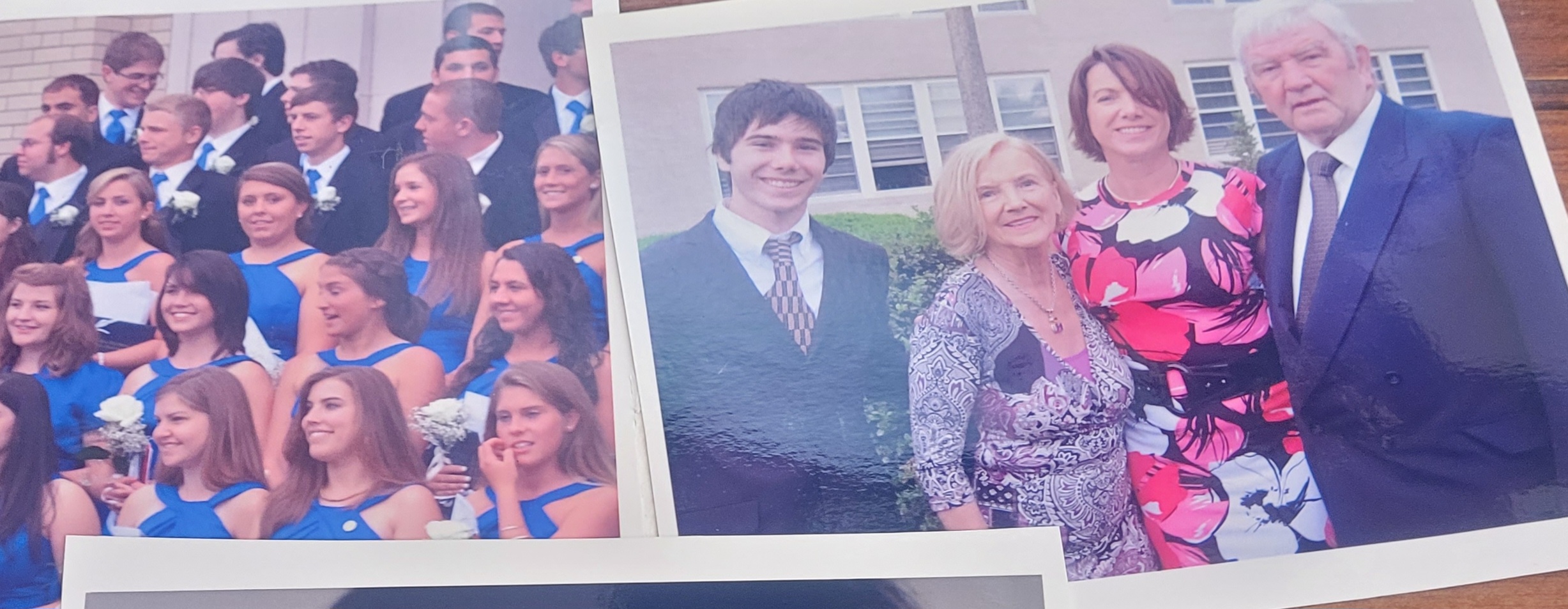
Some of the graduates including the person I specifically came to see, Cait, who now is a psychologist, as was her late father. And to the right, her younger brother, Charlie, grandmother Jennie, Janey, and the late John, whose nickname was "Jock" just like the patriarch of the series Dallas.

I still remember Charlie, then I think a Sophomore in the same school, telling me, before the ceremony that he planned on becoming a businessman. I smiled, and I knew he probably would. He is in the business and financial world now.

New York, New York, 2010. Bet you already recognize the sites here. Times Square. Grand Central. Radio City. St. Patrick's Cathedral. I usually try to make my visit to St. Pat's, Gothic personified and full of history, maybe not so much as in Europe, but close enough for the colonies.

And below, a really lousy picture of me, but a really lovely one of my cousin, Carol.

And, a touch of Central Park.

Finally, a swizzle stick from the Planet Hollywood that was in Times Square. Don't know if it's there now. The purpose of this photo? Reminder of the last time I saw my friend Noreen, who died only a few months later. I think of her often. What a sweet, kind soul she was.

Tuesday, October 10, 2023
Delores II
My father seems to have adapted the original story embedded in the last blog. Here it is.
DELORES II
Perhaps the original story was a true one. On the other hand it may have been a writer's attempt to bring the sublime to the ordinary. Furthermore, this tale also may be fanciful. I leave the judgment to you.
Well, her name really was Delores.
She was--as I portrayed her in a previous story, lovely. Tall, dark and blue-eyed, trim, touching, vivacious and given to impetuosity regardless of decorum, particularly manifest where decorum is called for--qualities I discovered later. More, anon.
The setting where it all began--for those who look for things I would rather not have you know--was pre-World War II. In a street lined on both sides with Germanic type Brau Hauses--in what was called Germantown-a little one block long enclave between Second and First Avenue in Manhattan, where there was music and dancing, where the girls came in groups and sat at tables exuding their charms, and the men clustered at the bar surveying the panorama of beauty so as to be ready to make their approaches as soon as the music started.
I am impelled by nostalgia to name some of these dance palaces. Those of you who have seen the movie Cabaret will envision the ambience. They were named as I remember, in part, The Gloria Palast, the Corso, the Platzl, the Grinzin and the Lorelei.
Walking on either side of the street, one could hear, as he rubbed shoulders with Nazi Bund members in uniform, Viennese waltzes and the meticulously timed tangos tht iimposed their rhythmic invitations above the importunate cacophony of traffic.
It was at the Lorelei I saw her first. She sat alone at a table, a study in casual elegance. Throughout the evening she refused the any suitors asking her to dance with an imperious dismissal. I was intrigued but not brave enough to present myself for summary rejection. My attraction to her was so strong I determined to employ some stratagem to invite her interest.
I did not attempt to approach her while there was music. I waited for the quiet of an intermission and walked to her table.
Before I could say anything she waved me to a seat. I was astounded. More surprisingly, she began to speak. "You want to know why I come here and refuse to dance--yes?"
I had no words in response.
"You want to know why I let you sit--yes?" She had a decidedly foreign accent. I managed an affirmative nod.
"Vee came here always and vee danced--ant vee held each other close--and then he was gone. 'I go for my country,' he said--'the fatherlant'--ant I hated him and the Fatherlant ant I did that night three year ago, ant I knew he would not come back. . ."
She stopped, taking a deep breath.
"It is three years we are married ant it iss our anniversary. Then I see you at the bar ant my heart leaps, 'he is back' I say aloud and ven you approach. I am sure it is him so much you resemble--even now vere you sit."
"Come," she said rising, 'you are back, come, vee dance like we used to, come, I want to hold you so you never leave again."
We danced as if we were one. Her body was close to mine. I could feel her heart pounding against my chest. I don't know if it was love I felt, but I responded and we danced till the head waiter ushered us out.
"Come," she said. "Vee go home."
We did. The doorman welcomed her, and me.
"Good evening Madam," he said and looked at me, smiling. "Ah, Herr Meisner, you are back."
There really is not much more to tell. It was 1940, a time of innocence. There was a war in Europe but it was far away. We had a happy year. When we were together, she held me close, her fingers on my arm, or holding my hand in the subway, or taxi, or at a party when we agreed to share ourselves socially.
If I withdrew, she would question immediately. "You do not love me," was always her plaint. Her eyes would glisten with a tear or two.
One night as we dined at the crowded Casino in the Park, outdoors, crowded, she cried out suddenly:
"You did not kiss me when you came home," then a preemptory, "kiss me now."
I bent obediently and she responded with such ferocity that the headwait remonstrated with me.
"Please, sir," he admonished.
To be frank, I cannot suggest that there was any severe suffering at the excess affection. Occasionally, the thought that she really loved someone else raised a shadow in my mind, but the thought was transitory. I loved her and there was nothing more she could give me that she had not already done.
When I received my notice to report to Governors' Island for military duty, she insisted on coming along. She did not cry. "Come back," she said, simply and clung silently and limp in my arms. We held hands over the restraining chain on the ferry until the moving boat separated us with the cruelty of the inexorable. I watched her forlorn figure fade gradually.
I came back, four years later. She was not there.
Monday, October 9, 2023
Delores By Constantine Gochis
A Dad story. You know, my father was a very good writer. He should have been officially published. He should I think have been vaguely famous as a writer. But there you are, sometimes things don't happen that should. Actually, in this world, mostly things don't happen that should, and things happen all too often that shouldn't. I attribute that to the consequences of Original Sin. But I digress.
DELORES
"Do you love me, really?" It is a question I hear from her--more often, now. Always I assure her, sometimes with words, sometimes with a kiss, fumbling ways men attempt to allay female distress. I take her in my arms and hold her tight, and glory in the sinuous loveliness of her body against mine, as it was then, long ago and I think, to tell the truth--not that I don't love her--but that I love her more, that I knew her in a different incarnation. She lived in another time and place, and I felt then the way I feel now. I do not tell her where, when and with whom. Surely, she would not understand.
She persists. "Was there someone before me? Was she as pretty as I?"
I could tell her that she was. I could tell her that when we first me I thought that it was a miracle, that she had come back, so remarkable was the resemblance, that it really was Delores who had returned to me after all these years. But I won't tell. I simply hold her close and stroke her long black hair. She is quiescent.
I feel a tremor of fear. Women sense things. The dread overwhelms me that she knows. I fear that somehow I will lose her for a second time.
But for now, she is asleep. I lie awake and remember Delores.
It is a name that has its origins in sadness, and, as it happens it was a time of joy sundered suddenly and turned to sadness.
I saw her first in a Florentine night club that was called, Il Pozzo di Beatrice, The Wall of Beatrice. She sat alone at a table as if waiting for someone. She was dark haired. More correctly, her tresses were long, ebony. She was dressed elegantly, also in dark shades. A tall glass rested on the table, which she sipped from time to time. There were no other uniformed men in the establishment. Like she, the other guests seemed too well caparisoned, too well fed and clothed to be victims of war.
When it became clear the one she expected was not coming, I approached her table and addressed her in my limited Italian. "Are you waiting for someone?"
"For my husband," she said. My expectations were shattered, but she smiled and told me she had been waiting for him for several years. She noticed my consternation, laughed and waved me to the empty seat. She continued, "He was reported missing at El Alamein. We used to come here often." She smiled and looked at me with amusement out of two very wide set blue eyes. It was at that moment I fell in love.
There is no new story here. We danced in perfect harmony. We walked together over the old Roman Bridge. We sipped Lacrima Christi on the Fiesole Hill overlooking the Duomo, the domed Cathedral, from the hills where Boccaccio regaled his friends with bawdy stories hundreds of years ago. We took a place abutting the Palazzo Vecchio, the Old Palace, where Michelangelo's David stood. We were in love, in our sanctuary, in the year the war ended, and the whole world was external to our love.
She asked me frequently if I truly loved her, whether she was my first love and would I come back to Italy for her. I promised always that I would.
One day she was gone. She left a note with a single phrase. "I love you but I must go." No explanation, just a sudden departure and inexplicable cruelty. I was distraught. At this point I blotted the memory from my mind and I turned and looked toward Elsa, who had been sleeping next to me.
She was awake. I was unaware she had been watching me for some time. She looked at me with her very wide set blue eyes. A tear made its way downward. "You were thinking of her!" she exclaimed.
I took her in my arms. She sobbed, "I felt you had gone away somewhere. It was like a bad dream. Don't ever leave me again, not even in memory!"
I pressed her sinuous body against mine and caressed the jet black hair that fell disordered against my breast, and kissed away the tear.
"There is no her, no yesterday," I assured. "There is only one love in my life."
I did not say her name.
Subscribe to:
Posts (Atom)