Friday, June 10, 2016

The Face in the Mirror


My mother died over 42 years ago, two thirds of my lifetime  ago.  It has been a long time since I had intense thoughts of and feelings about her. The touchstones of my existence, generally shared by a mother, I met alone. My youthful relationship with her was generally strained for reasons, never to be known fully and so I met those life transitions without much thought about her absence. I long ago was helped to realize that the reasons for her visible dissatisfaction and restrained rage was not due to my failings as a daughter, but to whatever inner torment she could not share even with her husband. And I have come to see her as the human being she was, married at a young 18, with a deep sadness neither spouse nor child could assuage.  She softened with illness. Perhaps, had she been given the time, age would also have softened her.


I am twelve years older than she was when she died. My trip to New York has brought her to my mind in a way that has never been the case before.


Maybe it is that I have softened with age. It surely is more than one person in the last month, from my Aunt Teri to my cousin Carol, to friends of Facebook, to readers of these pieces, have remarked on how much I look like her.

After all, it was said before, that I look like my mother. It is, perhaps, that I wasn't so eager for it to be the case. And now, having come to an understanding of the realities of life, and their vagaries, I now am embracing that possibility. What was the name of that old book, "My Mother, My Self"?  I read it when I was in my 20s. I don't think I grasped the relationship of me to her, or her to me. I think that when she died I was angry that her emotional distance could never be resolved. Door closed. Right?

Prompted by the observations of others that I look like her, that this face, my face, reflects some part of what she was, this time, I seem to be embracing it, even if part of that means I inherited a tendency toward weight.  When my mother was young, she had an 18 inch waist. Well, that's something I never had!!!!


My mother died long before the internet. There are so few remnants of her privately, and none, therefore, publicly.  I didn't even know there had been an obituary--my father handled it all that November. She died on the Monday of Thanksgiving week, the 25th. There could be no funeral or burial on the Thursday or Friday, the holiday weekend, so the one day wake was held on Tuesday and she was buried on Wednesday. I don't recall having a say in how things went down, nor did I think to ask why we couldn't wait a week. I remember only being stunned, not that she had died, that was a foregone conclusion for many months, but by the abruptness of her body's dispatch, and the forever shift of the world for my father, and me.  The only decision I recall making is what she would wear in the coffin, the outfit she had worn at the wedding of a friend of mine, just a month before.

Turns out there was a very short obit, another item I was given during my May trip, yellowed, glued to an envelope of my Aunt Rita's things. She too, would die, way too young in the 1980s.

So, what's the point?

Me June 10, 2016


Turns out, there is something of her still in this world.

The face in the mirror?  It is mine. It is hers.  It is ours. In me, she is still very much here.


Wednesday, June 8, 2016

The Ice Bucket of Townsend Avenue

I have always had strong memories of my parents' apartment on Townsend Avenue in the Bronx.  It was on the fourth floor of a five floor brick walk-up, a one bedroom facing the back alley and another bricked apartment building. I have tried to explain to those who did not know me then, for I lived the first 16 years of my life there, that the overall decor of the place was 1950s nightclub. It was organized in earth tones and curtains, complete with a bar built by my father. Pretty much the only people who were allowed into this incongruous space were my mother's sisters, in laws, and respective children, for birthdays and holidays awash in the latest cocktails. We kids, of whom I was the eldest, a very serious only child, were relegated to the bedroom, which was, when I was old enough, entirely my own. It too was brown and beige and full of curtains covering both built in and makeshift closet space. And lots of shelving for books. And mirrors along the one long wall in front of which was a Hardman and Peck upright piano.  I had begun to play the piano when I was nine and until I was 17 I was intent on developing an incipient talent, until it became a chore rather than a pleasure.  My parents had the Castro Convertible in the living room.  It was magical at night, when the drapes were closed and my father's international music accompanied by his mandolin blared over the cacophony of idle, inebriated adult conversation. In the day time, it was more library, as mirrors and bookshelves again covered the free walls, with just a touch of decay, for these old Bronx buildings were not well maintained any longer and they were infested with roaches no doubt survivors from pre-historic times. No one I knew lived quite as we did.

But for all the photographs I had (many were lost in a leak in my old garage where Dad had stored them) there seemed to be virtually none of us in that apartment. When I was in New York in May, my cousin Carol brought along boxes of photographs of my mother, my father, her mother, (who was an inveterate photographer I am delighted to say) my Aunt Teri, in whose apartment we assiduously pored over them. And among these photos were two that were taken on Townsend Avenue. To be sure, they only capture a tiny portion of the living room--these were fairly large apartments built in pre-war days--but finding them, my parents in the place and manner which was--well, as I knew them when I was so young, there was something, validating, something I needed to confirm what I remembered.

There is my father, about 47 in 1965, when I was 11 (I assume I was in the bedroom with my cousins when this picture was taken, I see a child's bottle on the stained glass like table-- we had three or four of those on which cocktail glasses were placed), looking classic movie star in his suit and tie, and my dramatic mother, maybe about 39, black Irish, so fair of skin, with nary a freckle and dark long locks that she always kept up when I knew her, wrapped in a hair rat and dressed in her characteristic unique style, complete with a recently gifted cigarette holder. They are at the bar. Oh, and yes, you see those curtains behind them?  We had a kitchenette, not a galley kitchen, so all of the appliances, the refrigerator, the sink, the stove, and in a little cubby hole built by dad, a black and white television, were lined against the wall covered by the curtain. My mother would slip in and out, allowing no one else (except my father) behind that curtain while she engaged in her culinary or serving ministrations.

Since I first got my hands on these pictures, I have been pouring over them, remembering that's the room in which I concluded there could be no Santa Claus because we didn't have chimneys, but only thin hot water pipes, that that is where the Christmas trees my dad brought home for decoration never measured up to my mother's specifications, where they were amused at me cavorting in a tiger costume, for Halloween, perhaps? Where I did my grammar school homework sitting on the floor using one of those stained glass tables as a desk, and looking forward to being able to watch "The Adventures of Superman" at 4:30 p.m. They were already in repeats by then. Memories of every kind flow back. Good. Not so good. Sad. Happy. I stood at the bar talking on the phone to Virginia Rohan, one of my best friends at Mt. St. Ursula, all worked up that Emma Peel  of the Avengers (and Diana Rigg, the actress) had left Steed because her husband, Peter, had finally been found in the jungles of Africa. My mother, who was not overtly affectionate to me, once let me lean against her, when neither she nor I could sleep, both of us on the floor, watching the Channel Nine Late Late Show, while dad slept on the Castro bed.

And then today, as I was considering how I wanted to write about these photos, and their re-discovery, I noticed the ice-bucket on the bar. In one picture, my mother is in front of it. In the other, she is behind it. I suddenly remembered. I had that bucket, still. Here, in California. That object was in the same photograph as was my mother. It took on, as objects do historically and personally, a sudden and intense meaning. A connection directly to her. To them.  Did I still have it? I thought it might have finally gone the way that things do, to the trash heap, even things of sentiment. I had confiscated it when my father died in 2008, if not before. But now, in 2016, did I still have it somewhere? It became urgent to know. And then I found it in the back of a kitchen cabinet.


The last bit of Townsend Avenue of them, and me, so many years ago. The building on Townsend Avenue is long gone. My mother died too young in 1974 of a virulent cancer. Dad died at a ripe old age, but still too soon, in 2008.

I broke into tears of thanksgiving, and loss. The bucket from our night club apartment is now prominently displayed on my pass through bar counter,  51 years and three thousand miles away from its original spot. I think it will be there for a while. Maybe it's time to use it again. And toast to them, my parents.


Some Regrets

That is the title of the next short short story from my father. When I was very young, I was leafing through the many books in our tiny Bronx apartment on Townsend Avenue when I found a photograph of a long haired, young, blonde girl wearing a bathing suit top and a grass skirt. She looked at the camera, or perhaps it was the young, but slightly older than she, man behind it, with affection. I asked my father who it was. He told me her name. Louise. She was someone he had briefly known, long before my mother was introduced to him, during the War, while he was waiting for assignment out of Spartanburg, South Carolina. He spoke of her with a fond tone. I did not ask much more. It seems he wrote about her when he returned to writing back in the 1980s and 1990s. It is a story in progress, still being edited, with cross outs. He wrote on it, "Edited copy--somewhat". Perhaps it would have been developed more. But here it is. With my idea of his edits.


SOME REGRETS

After the war, I made several trips to the south on military business.  Each time I neared Spartanburg, South Carolina, I got that urge to call.  I wondered what she looked like; whether time had been kind to her extraordinary beauty; whether life had thickened the loveliness of her youthful perfection; whether her long blood hair, luxuriant and golden, that shimmered in the light of a friendly sun, was now tied into the obscuring sadness of domesticity.

We spent several months of week-ends together, in the early part of 1943.  Se lived in a little village, some fourteen miles by bus, out of Spartanburg.  Her name was Louise. She was barely 18.

Each week was a kind of repetition of the last one.  She paraded me before the block long Main Street, usually to the ice-cream parlor, where the town youth gathered.  Everyone knew I was her "gentleman caller", her shiny, new second lieutenant.  Sometimes we walked on the thick, soft, browning pine needles in a quiet oasis of sli shedding trees.  We held hands, sometimes necked in the fashion of the day.  There were no serpents in this forest, and I sought no further knowledge.  It is kind of an idyllic memory partly enhanced by time, essentially true.  She was a kind of elf innocent in a long ago era of innocence.

When my orders came to leave, I asked her not to come to the bus station, but she insisted  She clung to my hand.  We sat in the Spartanburg depot. She sobbed continuously, her blue eyes reddened by the salt of her tears.  I am embarrassed, ashamed now, of this feeling.  These were the tears of Niobe. There was nothing, I felt, that entitled me to this sorrow.  There had been no great part of her that I could take and little I was free to give.

We did not embrace or kiss.  She held on to my hands up to the time I mounted the bus.  I watched her small disconsolate figure from the window of the departing bus, an empty ache gnawing at my breast.

She wrote to me for four years while I was overseas--treasuries of charmingly misspelled sentences that described her worlds of expectations and her need to see me again, accentuated by rows of X marks to indicate the kisses she could not deliver herself.

For these precious memories I am grateful.  But I do wish I made one more stop in that little village, just fourteen miles by bus out of Spartanburg, South Carolina.

Tuesday, June 7, 2016

Where Are the Snows of Yesteryear? A Take on Francois Villon's Famous Title By my Father

I might have mentioned in other blog entries that my father wrote short stories featuring a character named "Myra" who was a thinly disguised version of my mother. Here is a short short one.


Deciding what to keep and what to relegate to the yard sale pile is always a source of contention for Myra and me.  She has a simple philosophy. If it has no immediate use, dump it.  Terse. Laconic. Succinct.

My reverie is interrupted.  I hear Myra's voice from the corner of the dusty attic  Clearly she has discovered another of my treasures to dispose of.

"What's this," she says, holding up an album that has been carefully wrapped in plastic and tied with a string.  I recognize it immediately.  My heart skips a beat.

"Nothing important," I reply.  I don't know why I lied.  After all, it is nothing ore than an autograph album from an elementary school ceremonial.  It was our custom in those days, to inscribe some epigram of farewell in one another's book.  Today was graduation day. We were going on to High School.

Myra undid the string, sat on an orange crate, and began leafing through the album.

Perhaps it wasn't guilt. I felt that something private, something sacrosanct, was being invaded.

It was important, perhaps the most important:  The written exchanges of farewell was a rite of passage and the end of childhood years.  It was more than a matter of self-image, on how many students wanted to exchange amenities with me.

"Who was Estelle Abrams," came the voice from the orange crate.

"A mousy little girl," I said.

"Were you really?" added Myra.

"Really what?" I answered.

""The cleverest, she wrote, 'to the cleverest in the class.'"

I did not answer.

"And Selma Rabinowitz?" Myra followed up.

"Certainly not mousy," I admitted.  'Don't do anything I wouldn't do,' Selma had written.
Selma had grown to a challenging presence during school.  A daughter of Eve with all the primordial attributes intended by the Creator. But she hadn't been Elise.

These are reflections of memory matured by the passage of time.  There is no possibility of comprehension by the mature mind of the unexplored internal world of youth; of boys awakening from the slumber of childhood, thence to an epiphany of beauty that comes once in a lifetime.

On that day I suffered the importunities necessary to the ritual. All else was peripheral, wearisome. I was waiting for Elise.

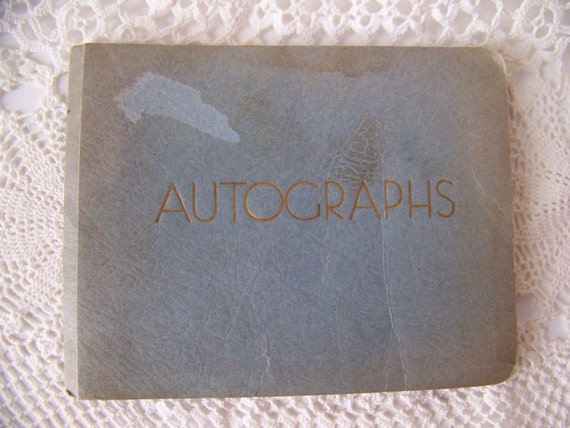
Vintage Autograph Book 1930s. Light Blue Autograph Book. School Memories Book. 1930s Decor. Old Love Letters. Antique Autograph Book. Poems

The class comedian and curse of the perpetually hysterical Miss Hurley, who taught Geography, made his mark.  What he wrote and what Oscar Schaeffer scribbled eludes me as of no consequential. Harold Steckel, fat and elliptical in shape, plagiarized Shakespeare, to wit:

"Is this a dagger which I see before me?" hardly appropriate to a graduation ceremony.  Bernice Cohen held my hand between her overly warm palms.  Still, Elise did not come.

"Honey," came the voice from the orange crate.  "Who was Elise?"

"Just another girl," I said.

I remembered the shy, tentative approach, her album offered to me as if she anticipated rejection. I do not recall what I wrote.

"Goodbye is a very sad word," was her phrase in mine.

"Honey?" came the voice again from the crate.

"Yes, Myra."  I held my breath.

"Was Elise pretty?"

"She was, Myra."

"Prettier than me?"

Monday, June 6, 2016

Maggie's Plan and the Easy Devolution of Life, Boundaries and Old Fashioned Story Telling

Maggies Plan TIFF There was hope that this film, well reviewed by critics, and recommended by a friend mutual to Len Speaks and me, would finally conquer the spate of films well reviewed by critics and recommended by friends that were just awful. Hello My Name is Doris, The Meddler and The Family Fang.

I report thusly. I didn't hate Maggie's Plan. I even kind of liked it. So, here's the story. Maggie (played by Greta Gerwig) is a thirty something single working at the New School in Manhattan who wants a child but has no romantic prospect. She has singled out a mathematician-pickle maker (yes, yes, that's what he is) friend, Guy (Travis Fimmell) to be the donor of sperm. He suggests the usual method of delivery. She declines, preferring a messy self injection in her bathtub. As this chapter of her solo life is about to unfold, she has met an adjunct professor of anthropology, John (Ethan Hawke) also at the New School, who fancies himself a novelist, but whose incipient talents appear to be a matter of indifference to his wife (Jullianne Moore) a rather famous professor at Columbia. In fact, John unknowingly interrupts the sperm injection  by appearing at Maggie's apartment so that further chapters of his novel (a thinly disguised lament on his married life with Georgette, his wife) may be praised unflinchingly by Maggie. On this is their quickie relationship built, and Maggie forgoes self insemination for the usual kind with her adjunct professor whom she also marries leaving the older Georgette in the proverbial dust of her older age. Maggie and John have a child who it is suggested might be Guy's mathematically inclined progeny-so that the injection of his sperm might not have been a-miss. This avenue is left unexplored in the movie.  But Georgette, and John's two children by their marriage, are still very much part of John and Maggie's life, well, more Maggie as she becomes the soccer mom Georgette never was and John could remain an absentee father.  Maggie realizes after her daughter is about two or three that her marriage to John was based on the flimsiest of premises, that John isn't much of a writer, but he is very much self absorbed, and hatches the plan of the title to give him back to Georgette, with whom she has developed a solidly cool friendship. Georgette and John it turns out are really perfect for each other as ships passing in the night who happened to manage to have two children who will probably end up in a years long unsuccessful therapy (that could be another movie entirely).

So Maggie sets it up that John will meet up "by chance" with Georgette at a conference in Canada. And that faithfulness will once again go by the boards (that's my take) and the ships will collide over anthropology talk and snow bound rebound romance. And so it happens. Oh, yes, What was wanted was not really what was wanted and the ships, so to speak, are righted.

In the old days of movies, everyone would have been punished. Not that I am suggesting I want this to have happened to Maggie, Georgette et. al. I am a creature of the generation in which I live, and so, as I said, I found the film distressingly enjoyable. Distressingly, because everything about it just proves we are living in a cesspool of moral confusion. No boundaries. Feel it. Do it. Three kids? Good luck to them. This is our world. There are no bright lines. And doing what is right? Like not having affairs on a spouse? Like delaying gratification?

What bothers me? It is that I am so immersed in the ambiguities of my society, of everything around me, I actually am NOT bothered by the fact that these people have no rules or respect for other human beings such that they recognize the destruction they wreck.

The old movies? Well, they were full of it too, right?  I mean, it was never boy meets girl, girl marries boy and they live happily ever after. Fact is, boy met girl, boy married girl, they had children who heard them fight night after night their whole lives, but "stayed together " for the kids. That wasn't better was it?

I'm thinking that maybe what was better is that there were rules, and rights and obligations. The weakness of those times was that there was a pretense that no one ever failed and that caused too many heartaches, but at least there was some ideal, some things that were transgressions, that weren't, shall we say, a good idea.

There is nothing to guide us anymore. Well, there is, but that seems rather, how shall we say, amusingly outre.

I guess it would be too boring for Maggie to meet a nice guy, get married, form a little society with two and one half children, and celebrate her 50th anniversary. It wouldn't make much of a movie these days.  But I think I just might watch "How Green Was My Valley" tonight about two heroic people who fell in love but did not break up families to indulge themselves.


There Were No Tears

Whenever Dad spoke of his parents, it was not with warmth.  He would begin a tale of familial woe with the words, "My parent were peasants. . . .". But there was something else, a deep regret, a deep sadness, so much so that once or twice, after several glasses of wine, he actually broke down. He considered that crack in the facade "shameful". The best I can ascertain, as nothing was ever discussed, on either side of the family tree, is that Dad's father was an unbending Greek who tried to build an ethnic moat around his children, though having married out of the group, to a first generation Italian girl. He drank, sang Greek songs and was abusive to wife and children. His wife, a burly four foot eleven terror, unlikely thus to find someone with whom to stray, would berate him as he had the home brew brought up from the basement with the words to his eldest daughter, "Georgia, catch me some wine." There were nine children, only seven of whom survived,into adulthood, and only three into old age.  Of those who survived, there was among them little happiness.

The story that follows is a rare one exposing his real family pain, with a bit of forgiveness mixed therein--though fictionalized in large part. He would never say which was fiction and which was truth, but I can guess. Maybe so can you.

There Were No Tears

Funny what the smell of flowers does to me.  I suppose I ought to have a little more sense, now, but you know how it is--you just don't get rid of those things so easy.

I guess it all goes back to the time Grandpa died.  Now mind you, I liked the old guy, but you know how a kid is about such things.  Well, Mom didn't--she said I had to pay my respects to the dead--and she dragged me into the parlor where they had him laid out.  I remember I put up quite a scrap  In fact, I don't think she'd have got me in there if it wasn't for what she said.

"He''ll come back and haunt you every night."  She wasn't just trying to frighten me---I know that now--Mom was pretty superstitious herself.  You know how the old people are from the other side. Well, that clinched it.  I quit fighting and let her take me by the hand.

The parlor door was closed--we had one of those old fashioned houses that still had rooms with two sliding doors.  With her free hand, Mom slid open one of the doors, never letting go of me for a second, then she pushed me into the room.

It was pretty hot that day--I think it was one of those unseasonably warm Fall spells we were having--and the room was crowded with friends and relatives, some sitting on those chairs the undertakers rent out, others standing around gabbing, and all around there were wreaths and bouquets in all kinds of shapes, crosses, archways and I don't remember what else, and the air was moist and thick with the sickening sweet perfume of dying flowers. 

I wanted to vomit. Behind me Mom kept pushing me toward the casket. "Kiss your grandfather for the last time," she kept saying, "go on, now, kiss him goodbye," and she started crying, "O Dio. . .Dio. . .mio Padre. . .Padre mio. . ."

I tried not to look at him as I bent forward to kiss him.  His forehead was cold, like marble, and he smelt sweet and damp--later on someone told me it was embalming fluid. I was scared.  My lips barely touched his stone-like brow and I turned and ran from the room.  Outside I puked. My stomach kept retching and retching until it hurt.

And that night it seemed the smell of flowers was all over the house, wherever I went. I couldn't seem to get that damp-sweet fragrance off my mind.  And then I dreamed. I forget what it was about but I know it was something that would scare the pants off a nine year old kid--and there were flowers in the dream--that much I do remember. Then finally I slept but it was only after Mom said I could have the light on that night.

Well, I don't mean to say that it's anything like that now.  There's the same wreaths and crosses--though mostly crosses--and the friends and relatives are all sitting around on those hard-backed wooden chairs and there's that sick-sweet smell of flowers in the air. There's not much weeping, now, just an occasional sob.  They're getting ready for the final goodbyes and I guess that's when it will really break out.

Not that he was ever really tough. Oh, I guess a lot of the things he did just can't be glossed over like that, but I think I know why he did them. In his own peculiar way he must have wanted the best for all of us; but I don't think that the others would believe that if I told them.  You really can't blame them, though. It isn't easy to forgive a man who's played God all his life and made a mess of a lot of other people's lives. 

There's Emilio going over now.  He bends over to kiss his brother. I wonder what he's thinking? I wonder what I would feel in his place?

Uncle Emilio--we all call him Uncle Mil--was always a gentle quiet kind of guy, reserved--Mom used to say he'd had a good education on the other side--thoughtful, the kind of guy you'd like to know, but can never get close to.  He used to come over to the house once in a while with his wife.  Funny about his wife--at least it seemed so then--he never used to talk to her much except maybe to say yes or no to a question, and she seemed always to be waiting on him hand and foot.  Of course we never thought this was the least bit out of the way--lots of the old people say that when you go back to the old country to get married you really get a wife.  When I got older I began to understand about such things, and then later Mom let the whole story slip in an argument with the old man.  I kind of felt sorry for Uncle Mil after that.  The girl he wanted to marry was really beautiful. I wasn't to young to be able to see that he must have loved her very much. But the old man was always so dead set against American girls--they bobbed their hair and wore short skirts. I don't exactly know what happened, but after a while she didn't come to the store anymore to see Mil and the same year Mil sailed for Europe "to pick himself a lemon in the Garden of Eden" as Mom used to put it.  But I think she was being just a little spiteful.  

Take for example Gino's wife.  Gino is the old man's youngest brother.  I think he was about fourteen when the old man brought him over. Gino's wife never had much use for any of us and most especially she hated the old man. Seems she felt the old man cheated his brother and kept too large a slice of the business for himself.  Course that isn't true at all, since the business was his in the first place and making his brothers partners was pretty dumb the way I see it. But's that how the old man was, I guess. Anyway, I don't think it was the old man she hated so much.  The way I figure it, she never did hit it off with her husband but if she had any complaints along those lines, I know she'd be too scared to air them.  Gino's been here a long time but those old country ideas don't die so easy.

Gino really hated the old man though.  At a time like this your imagination kind of plays tricks with you but the way he looks over at the coffin now and then gives me goosebumps. 

Years ago he was a pretty happy-go-lucky fellow, I understand, liked his good times and didn't care too much about the business.  He used to be crazy about the movies, especially the pictures with Douglas Fairbanks.  You know how it is with a lot of these very little guys, they like to identify themselves with big heroes.  He was a great story-teller--when he could get someone to listen to him. I used to be crazy about the stories he' tell, especially about a character named D'Artagnan.  Well, the old man never had too much patience with Gino and I must say he did have a nasty tongue.  I suppose he thought it was all for Gino's own good, but these little fellows don't like you to make a fool of them all the time, particularly in front of people.  I used to wonder why he took a lot of the stuff he did.  You'd think he'd know things are different over here.  Well that's something that's hard to explain about old country people.  I don't really understand it very well.

Then again you can't explain it by putting the label "old-country" on it.  For example, Mom was born here; 'course her folks were old country--but still she shouldn't have taken what she did.  She's over there crying now, but that's only because it's the thing she's supposed to do.  I heard her cry when her father went and then a little later when her mother died and it's not the same thing.  I don't guess she really hates him anymore--I don't think there's that much feeling in her one way or another. Not for a long time. She looks so old and beaten--I wonder if she's ever laughed or smiled as if it were coming from inside.  Funny not being able to picture your own Mom smiling. But you just don't laugh away thirty-nine years of struggle--of continuous child bearing--she had nine though there's just three of us left--you just don't smile away the physical beatings the unjust accusation of a bitterly jealous man. But that's just it. He loved her very much.  If he had only been less proud--less old country--if he had only known that all she needed was a caress, a soft word, a little trinket, a little love that shows, that's all it would ave taken.  But he didn't know. I know he didn't.

He didn't understand Tina either.  God!  How they grew to hate each other. She's got her wish now  I wonder how she feels? I wonder if it's enough for her to see her father dead?  Her eyes are cold and her mouth a tight thin line.  She used to have such a pretty mouth and laughing eyes.  She was so much in love with Jeff.  I could always tell when she was sneaking out to keep a date with him--the old man never would have heard of bringing a fellow to the house.  Where he came from the father arranged such things.  And sometimes I used to be her alibi  We'd tell the old man we were going to the movies together and she'd meet Jeff and I'd it it out alone in the show.  A lot of times I had to see the features over twice and then she'd finally pick me up and we'd rush ho together. And she'd be laughing and her cheeks would be flushed with happiness. She'd be so pretty.  Ad then one day the old man got wise, somehow, and he caught them together.  "You little whore--you dirty little whore!"

But she didn't stop seeing Jeff after that.  It seemed to me she had a lot of nerve in those days.  She'd just get dressed up and off she'd go--and she didn't seem to care whether the old man knew or not. What's even funnier, he didn't say a word to her--it was almost as if she no longer existed for him.
Then--it was all so sudden--she didn't go out anymore and her eyes didn't smile and she never laughed. She just kept to her room all the time.  And all the time Mom was like a mother hen, bringing her chicken soups and milk and the kind of food they tell you builds up.  Often Tina would cry for hours and the sobbing made you feel funny all over.  And she would say over and over "I wish he were dead. . .I wish he were dead. . . I wish he were dead."  Then she went away for a while to my Aunt Rosa and we all knew shy; but no one ever mentioned it.  She's got her wish now.  I wonder how she feels?

I know it's different with Elsa. How she cried yesterday! She really loved her father. I'll never understand how she could. They say you don't take anything with you when you go but he did.  When they close the lid for the last time, Elsa will be locked within the coffin. She's only thirty-seven. But she's dead as the still body in the coffin.

Once she wanted to marry.  It seems that's all she wanted out of life, to marry and have kids and keep a house for her family.  There was a fellow.  He was going to be a doctor  I called him "Doc". He just didn't believe people acted this way these days anymore.  He was all for coming to the house and asking the old man outright.  But she begged him not to--she was so scared-so timid.  and the months passed into years and finally "Doc" didn't ask anymore. Then she read in the local news he'd married and she cried, not out loud like some girls would have--just a few tears trickled down her cheeks. She locked the pain in her heart with her cries.

Yet yesterday, she cried and her thin little body shook with tremendous sobs. "Come back, Papa" she cried, "Papa, Papa please come back."  They had to drag her from the coffin. 

Well, I wonder what he's saying, if there's such a thing as the beyond.  I know he saw it all before he went---at least a little. You see I watched him go, little by little.  For him the nights were long. He didn't sleep. Sometimes, the pain would be intense and he would moan and I would know it must have been terrible because he hated any show of weakness.  And even though I needed sleep I used to sit up with him at night and we would talk.  Sometimes I would carry him downstairs in the daytime and wheel him to the park.  Once he cried a little.  I made believe I didn't notice.  "It's so beautiful here," he said.  It was as if he had never seen beauty before.  It was Spring in the park and life was beginning again.  And we would talk some more and then, suddenly I think I saw, I think I knew what he had been trying to do.  I don't guess I can really put it into words. I suppose it's something we all want one way or another.  We've got to leave our mark here some way--you just can't leave it all cold.  "Dust thou art, unto dust.  .," what a terrible prophesy.  The artist must know what I mean, the sculptor must know as he chips away at stony formlessness.

There's activity in the room though no one is really moving.  It's almost as if the room itself just heaved a big sigh.  They're getting ready to close the lid now.  Yes Pop. You left your mark.  It doesn't show but it's there nevertheless, raw and bleeding.  

But you just didn't know.  I know you didn't.


Saturday, June 4, 2016

Southern Hospitality

It drives me crazy that I began other blogs some years ago, and because of a combination of computer glitch and my poor expertise in relation to it, I cannot access them any longer so I can add to them. There is DjinnfromtheBronxTwo, and Legacy of a Courtly Curmudgeon, the latter intended to be entirely about my father and his life before, and after, my mother, and to include his writing.  Losing access meant losing momentum, even more so than has the interruption of life's ordinary activities. I have this current blog, DjinnfromtheBronxChapterThree in which I now intend to carry on the entries about and writing of my father. It would be my goal to get EVERYTHING he wrote on the blog, to scan as many photos of him, my mother, me, my relatives, and friends on here, my way of leaving something behind that won't end up in a trash can because I have no descendants. It would be a lot to hope that some of this stuff ends up in a shop somewhere--and that maybe some soul who likes personal histories would pick it up and cherish it, as I have items of people I never knew. But assuming that will not be likely, this is my family/personal archive.

So, today's entry is another of Dad's stories, one that he did in his life history class with Bea Mitz many years ago.  Hence the title of this entry--Southern Hospitality.

Sergeant Greenspan was my friend, an unusual circumstance in the military of 1942, Enlisted men, generally, had no friends in the upper ranks. But the Sergeant and I shared a bond, practically non-existent in South Carolina, land of Magnolias and mint juleps, because of our common roots in the Bronx.  We bonded, if only for the need to communicate in a comprehensible language.  After basic training concluded, passes were given and Greenspan and I made scouting missions to Columbia, the nearest town to our digs at Fort Jackson.  These missions were generally fruitless in terms of scrounging a date.  After several attempts, we decided the best we could hope for in a town outnumbered three to one by soldiers was a butterflied shrimp dinner at a Greek restaurant on Main Street.

So imagine my surprise when Greenspan collared me and announced, "We got dates for Saturday night."  It turned out that the sergeant, whose functions made him privy to select information in the orderly room, preempted an invitation before it could be seen by anyone else.  It read: 'Two girls will entertain a pair of GIs for dinner and Bridge, Saturday evening, eight p.m.'.

"But I don't play Bridge," I protested.  "Never mind," said Greenspan, "I'll teach you some preliminary basics. I don't plan to waste a Saturday night at cards, anyhow."  He was as good as his word. At least he tried. Even though I quickly forgot his Bridge instructions, I decided to trust to Providence that all would go well with this gala evening. 

Saturday night arrived and so did Sergeant Greenspan resplendent in his dress uniform. His trousers had creases that appeared to be permanently installed; his shoes were spit shined.  I could not emulate his sartorial elegance but my uniform was newly starched for the occasion.

It was an evening to splurge. We shared a taxi, avoiding the buses crowded with GI's. We arrived at the address early. Greenspan took time to tell me his "military" plan for the evening.  At precisely one minute before the appointed hour, I knocked on the door of a Civil War vintage frame house.  I heard footsteps approaching the entry.  The door opened slowly and there stood a woman of advanced age, perhaps in her late sixties.

She smiled and called to someone upstairs, "The boys are here Hannah."  Shen then opened the door wide to admit us and added, "The other girl will be down in a minute."